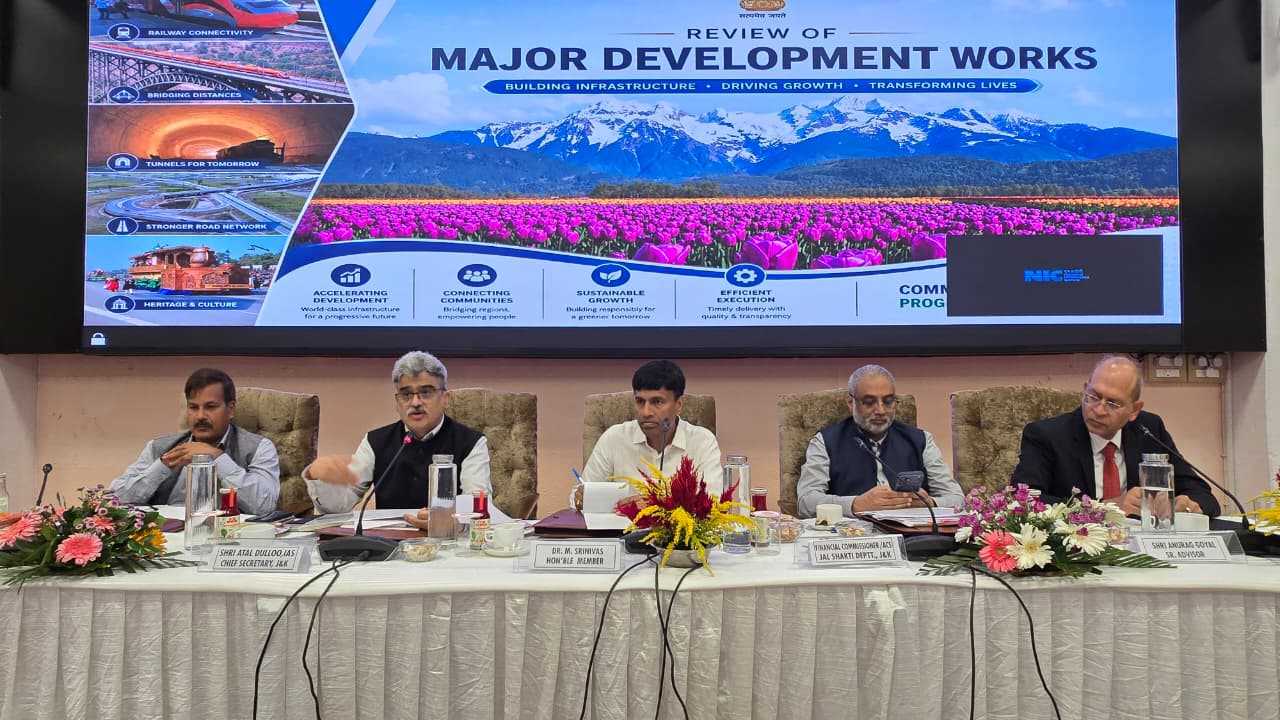
Srinagar, Aug 27: Member, NITI Aayog, Dr. N. Srinivas on Wednesday said Jammu and Kashmir has moved from a phase dominated by concerns over safety and security to one increasingly focused on growth and development, calling for stronger institutional collaboration to accelerate the Union Territory’s progress.
Dr. Srinivas made the remarks while chairing a review meeting at SKICC, Srinagar, to assess major development projects and the overall development scenario in J&K. The meeting was attended by Chief Secretary Atal Dulloo and senior Secretaries of various departments.
He said the changing development landscape requires greater emphasis on effective implementation, measurable outcomes and institutional cooperation. Stressing the principles of cooperative and competitive federalism, he called for sharing successful practices and developing models that could be replicated across sectors.
Dr. Srinivas said NITI Aayog could serve as a platform to bring different stakeholders together and facilitate coordinated interventions. He urged departments to identify specific requirements where policy, technical or institutional support could help accelerate development.
Chief Secretary Atal Dulloo highlighted agriculture and horticulture, food processing, industry, tourism, R&D, skill development and MSMEs as key areas for strengthening J&K’s economic base.
He stressed the need to promote high-value, low-volume products such as apple, walnut, cherry and almond, while expanding processing and value addition within the UT. Greater investment in apple juice and other food-processing facilities, he said, could raise farmers’ incomes and strengthen the local economic ecosystem.
Dulloo also called for stronger university-industry linkages in research and development, skill development aligned with emerging opportunities, and a more robust MSME ecosystem. He underlined the potential of the New Central Sector Scheme (NCSS) to attract investment and promote industrial growth.
Tourism, he said, should create greater opportunities for local entrepreneurs and businesses, while institutional partnerships, including with IIM Jammu, should be leveraged for industry data and evidence-based policymaking.
The meeting reviewed major projects across roads and railways, power, drinking water, agriculture, industry, tourism, health, education and urban and rural development.
In connectivity, progress on the Delhi-Amritsar-Katra Expressway, Jammu-Srinagar National Highway, semi-ring roads and other highway projects was reviewed. Eighteen new highway projects were sanctioned by the Centre during 2025-26.
Under PMGSY and NABARD, 1,074 projects worth ₹4,967.69 crore have been approved since 2021-22, with 467 completed and 607 under implementation.
The power sector review noted ongoing hydropower projects with a combined capacity of 3,014 MW and investment of ₹22,207 crore. These projects are expected to generate around 5,800 million units annually, with J&K targeting a doubling of hydropower generation capacity by 2028.
Under Jal Jeevan Mission, rural tap-water coverage has risen from 31 per cent to 81 per cent, while 901 villages have been certified as Har Ghar Jal.
The ₹1,800-crore J&K Competitiveness Improvement of Agriculture & Allied Project is being implemented across 90 blocks and is expected to benefit around three lakh households.
Industrial investment also registered a record, with ₹5,824.42 crore realized during FY 2025-26. Another ₹1,635 crore has been realized during the current financial year up to July 2026.
The review also covered health and education infrastructure. AIIMS Jammu has been operationalized, while AIIMS Kashmir is 75 per cent complete. Health and Wellness Centres have increased to 3,175, with 530 ambulances networked under the 102-108 emergency service.
In education, the meeting reviewed the operationalization of IIT Jammu and IIM Jammu, expansion of higher education infrastructure and growth in professional and nursing seats, along with smart classrooms, VR laboratories and ICT facilities.
Under PMAY-G, 3.27 lakh of 3.35 lakh sanctioned houses have been completed. Progress under Smart Cities Mission, AMRUT, Swachh Bharat Mission and PMAY-U was also reviewed.
The meeting further noted advances in digital governance, including e-Office, online government services, digitisation of revenue records and grievance redressal through the JK SAMADHAN platform.

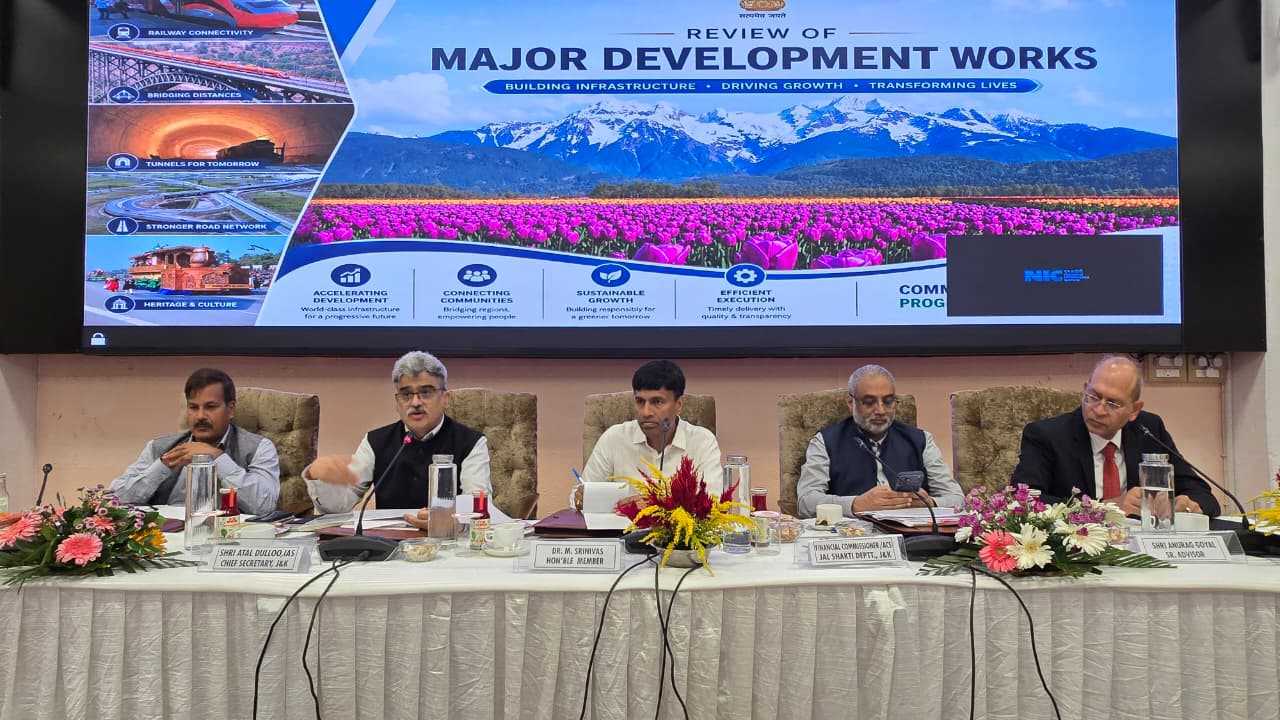
Srinagar, Aug 27: Member, NITI Aayog, Dr. N. Srinivas on Wednesday said Jammu and Kashmir has moved from a phase dominated by concerns over safety and security to one increasingly focused on growth and development, calling for stronger institutional collaboration to accelerate the Union Territory’s progress.
Dr. Srinivas made the remarks while chairing a review meeting at SKICC, Srinagar, to assess major development projects and the overall development scenario in J&K. The meeting was attended by Chief Secretary Atal Dulloo and senior Secretaries of various departments.
He said the changing development landscape requires greater emphasis on effective implementation, measurable outcomes and institutional cooperation. Stressing the principles of cooperative and competitive federalism, he called for sharing successful practices and developing models that could be replicated across sectors.
Dr. Srinivas said NITI Aayog could serve as a platform to bring different stakeholders together and facilitate coordinated interventions. He urged departments to identify specific requirements where policy, technical or institutional support could help accelerate development.
Chief Secretary Atal Dulloo highlighted agriculture and horticulture, food processing, industry, tourism, R&D, skill development and MSMEs as key areas for strengthening J&K’s economic base.
He stressed the need to promote high-value, low-volume products such as apple, walnut, cherry and almond, while expanding processing and value addition within the UT. Greater investment in apple juice and other food-processing facilities, he said, could raise farmers’ incomes and strengthen the local economic ecosystem.
Dulloo also called for stronger university-industry linkages in research and development, skill development aligned with emerging opportunities, and a more robust MSME ecosystem. He underlined the potential of the New Central Sector Scheme (NCSS) to attract investment and promote industrial growth.
Tourism, he said, should create greater opportunities for local entrepreneurs and businesses, while institutional partnerships, including with IIM Jammu, should be leveraged for industry data and evidence-based policymaking.
The meeting reviewed major projects across roads and railways, power, drinking water, agriculture, industry, tourism, health, education and urban and rural development.
In connectivity, progress on the Delhi-Amritsar-Katra Expressway, Jammu-Srinagar National Highway, semi-ring roads and other highway projects was reviewed. Eighteen new highway projects were sanctioned by the Centre during 2025-26.
Under PMGSY and NABARD, 1,074 projects worth ₹4,967.69 crore have been approved since 2021-22, with 467 completed and 607 under implementation.
The power sector review noted ongoing hydropower projects with a combined capacity of 3,014 MW and investment of ₹22,207 crore. These projects are expected to generate around 5,800 million units annually, with J&K targeting a doubling of hydropower generation capacity by 2028.
Under Jal Jeevan Mission, rural tap-water coverage has risen from 31 per cent to 81 per cent, while 901 villages have been certified as Har Ghar Jal.
The ₹1,800-crore J&K Competitiveness Improvement of Agriculture & Allied Project is being implemented across 90 blocks and is expected to benefit around three lakh households.
Industrial investment also registered a record, with ₹5,824.42 crore realized during FY 2025-26. Another ₹1,635 crore has been realized during the current financial year up to July 2026.
The review also covered health and education infrastructure. AIIMS Jammu has been operationalized, while AIIMS Kashmir is 75 per cent complete. Health and Wellness Centres have increased to 3,175, with 530 ambulances networked under the 102-108 emergency service.
In education, the meeting reviewed the operationalization of IIT Jammu and IIM Jammu, expansion of higher education infrastructure and growth in professional and nursing seats, along with smart classrooms, VR laboratories and ICT facilities.
Under PMAY-G, 3.27 lakh of 3.35 lakh sanctioned houses have been completed. Progress under Smart Cities Mission, AMRUT, Swachh Bharat Mission and PMAY-U was also reviewed.
The meeting further noted advances in digital governance, including e-Office, online government services, digitisation of revenue records and grievance redressal through the JK SAMADHAN platform.
© Copyright 2023 brighterkashmir.com All Rights Reserved. Quantum Technologies