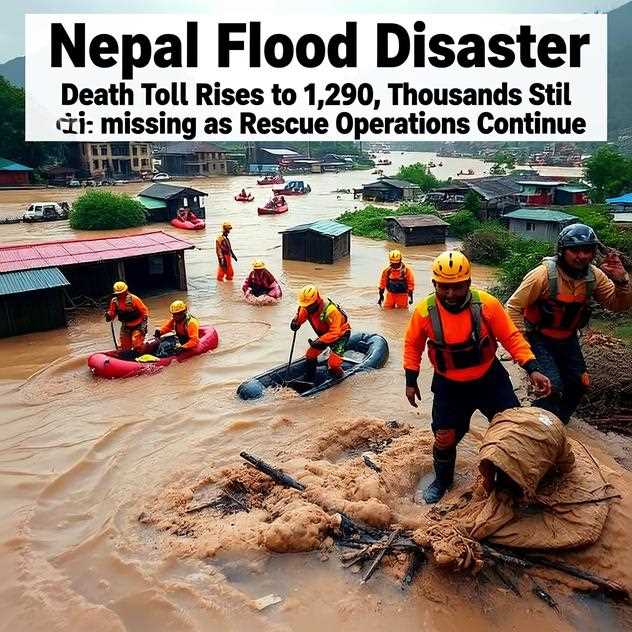
Kathmandu, September 4: Nepal is facing one of its worst natural disasters in recent years as rescue and recovery operations continue across areas devastated by catastrophic flash floods, landslides and a massive debris flow along the Trishuli River and nearby valleys.
The death toll has risen to 1,290, while more than 4,700 people remain missing. The casualty figures continue to change as rescue teams reach remote and previously inaccessible areas and recover bodies buried under mud, rocks and debris.
The disaster began on August 26 after a massive slope failure involving a glacier in the Langtang National Park area near Nepal's border with China triggered an enormous debris flow. The surge carried ice, rocks, mud and water downstream through the Lende Khola and Trishuli River systems, affecting settlements, highways, border infrastructure and hydropower projects.
The initial slope failure generated energy equivalent to a magnitude 5.2 earthquake and sent debris and floodwaters travelling nearly 100 kilometres downstream. The event buried or destroyed significant infrastructure, including the Rasuwagadhi border area and a major highway linking Nepal and China.
The scale of destruction has severely complicated rescue efforts. Entire sections of the Trishuli River Valley have been covered by mud and rubble, while roads and bridges have been washed away or buried. Several villages and key transport links remain difficult to access.
Rescue teams have also been searching hydropower facilities where hundreds of workers were caught by the sudden surge. Around 900 people were initially feared trapped across six hydropower projects.
On Friday, two workers were rescued alive from a tunnel at the Upper Trishuli 3A Hydropower Station, nine days after the disaster. Their rescue has renewed hopes that other missing workers could still be found alive inside tunnels and enclosed structures.
Nepal's Army and police remain at the forefront of the search operation, supported by technical teams and international experts. Teams from India, South Korea, China and Australia have also contributed to the wider response.
The disaster has created a major humanitarian challenge. Thousands of people have been displaced after homes were swept away or buried. Officials estimate that at least 7,500 houses have been destroyed, while approximately 20,000 homes may require reconstruction.
Damage to roads, bridges, electricity infrastructure, water supplies and other essential services has further complicated relief operations. Several affected communities remain dependent on emergency assistance as authorities work to restore transport and basic services.
Nepal has estimated overall property and infrastructure losses at around 387.5 billion Nepalese rupees, equivalent to approximately $2.56 billion. The government estimates that about $52.6 million will be required during the first four months of recovery for road reconstruction, temporary shelters, drinking-water supplies and restoration of electricity and other essential services.
The disaster has also affected the Nepal-China border region. China's Tibet region has separately reported 21 deaths and 541 people missing, adding to the scale of the tragedy across the Himalayan region.
Families of missing people continue to wait for information as rescue teams work through devastated areas. In some communities, the absence of recovered bodies and the prolonged search have forced families to conduct symbolic funeral rites.
The disaster has raised renewed concerns about the vulnerability of Himalayan communities to sudden landslides, glacier-related hazards and extreme weather. The scale and speed of the debris flow have also highlighted the importance of stronger monitoring systems, early-warning mechanisms and disaster preparedness in mountain settlements.
For Nepal, the immediate priority remains locating survivors, recovering victims and restoring access to affected communities. Authorities are simultaneously beginning the difficult process of rehabilitation and reconstruction.
With thousands still unaccounted for and large areas yet to be fully searched, the casualty figures are expected to remain fluid in the coming days. Rescue teams continue to clear debris and search damaged infrastructure, hoping to find more survivors while recovering those who lost their lives in one of Nepal's most devastating recent disasters.

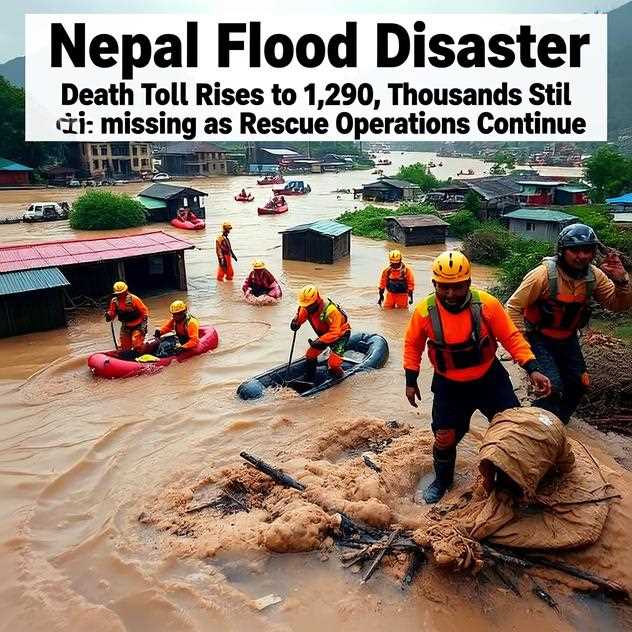
Kathmandu, September 4: Nepal is facing one of its worst natural disasters in recent years as rescue and recovery operations continue across areas devastated by catastrophic flash floods, landslides and a massive debris flow along the Trishuli River and nearby valleys.
The death toll has risen to 1,290, while more than 4,700 people remain missing. The casualty figures continue to change as rescue teams reach remote and previously inaccessible areas and recover bodies buried under mud, rocks and debris.
The disaster began on August 26 after a massive slope failure involving a glacier in the Langtang National Park area near Nepal's border with China triggered an enormous debris flow. The surge carried ice, rocks, mud and water downstream through the Lende Khola and Trishuli River systems, affecting settlements, highways, border infrastructure and hydropower projects.
The initial slope failure generated energy equivalent to a magnitude 5.2 earthquake and sent debris and floodwaters travelling nearly 100 kilometres downstream. The event buried or destroyed significant infrastructure, including the Rasuwagadhi border area and a major highway linking Nepal and China.
The scale of destruction has severely complicated rescue efforts. Entire sections of the Trishuli River Valley have been covered by mud and rubble, while roads and bridges have been washed away or buried. Several villages and key transport links remain difficult to access.
Rescue teams have also been searching hydropower facilities where hundreds of workers were caught by the sudden surge. Around 900 people were initially feared trapped across six hydropower projects.
On Friday, two workers were rescued alive from a tunnel at the Upper Trishuli 3A Hydropower Station, nine days after the disaster. Their rescue has renewed hopes that other missing workers could still be found alive inside tunnels and enclosed structures.
Nepal's Army and police remain at the forefront of the search operation, supported by technical teams and international experts. Teams from India, South Korea, China and Australia have also contributed to the wider response.
The disaster has created a major humanitarian challenge. Thousands of people have been displaced after homes were swept away or buried. Officials estimate that at least 7,500 houses have been destroyed, while approximately 20,000 homes may require reconstruction.
Damage to roads, bridges, electricity infrastructure, water supplies and other essential services has further complicated relief operations. Several affected communities remain dependent on emergency assistance as authorities work to restore transport and basic services.
Nepal has estimated overall property and infrastructure losses at around 387.5 billion Nepalese rupees, equivalent to approximately $2.56 billion. The government estimates that about $52.6 million will be required during the first four months of recovery for road reconstruction, temporary shelters, drinking-water supplies and restoration of electricity and other essential services.
The disaster has also affected the Nepal-China border region. China's Tibet region has separately reported 21 deaths and 541 people missing, adding to the scale of the tragedy across the Himalayan region.
Families of missing people continue to wait for information as rescue teams work through devastated areas. In some communities, the absence of recovered bodies and the prolonged search have forced families to conduct symbolic funeral rites.
The disaster has raised renewed concerns about the vulnerability of Himalayan communities to sudden landslides, glacier-related hazards and extreme weather. The scale and speed of the debris flow have also highlighted the importance of stronger monitoring systems, early-warning mechanisms and disaster preparedness in mountain settlements.
For Nepal, the immediate priority remains locating survivors, recovering victims and restoring access to affected communities. Authorities are simultaneously beginning the difficult process of rehabilitation and reconstruction.
With thousands still unaccounted for and large areas yet to be fully searched, the casualty figures are expected to remain fluid in the coming days. Rescue teams continue to clear debris and search damaged infrastructure, hoping to find more survivors while recovering those who lost their lives in one of Nepal's most devastating recent disasters.
© Copyright 2023 brighterkashmir.com All Rights Reserved. Quantum Technologies