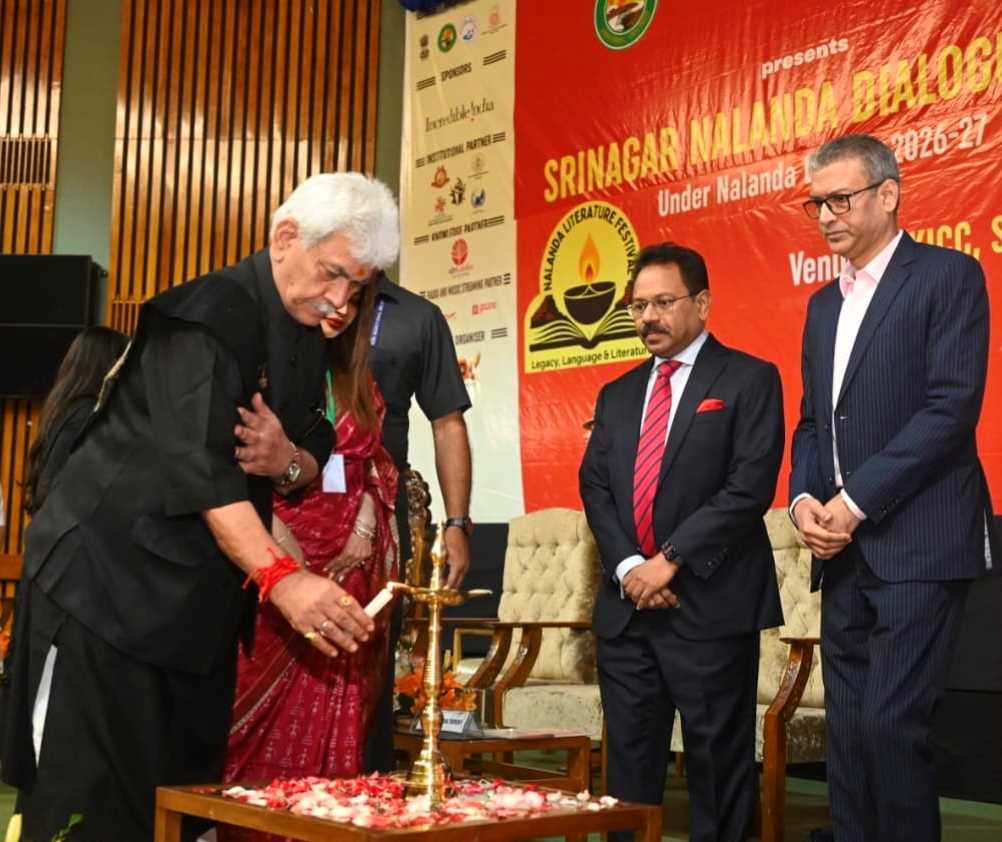
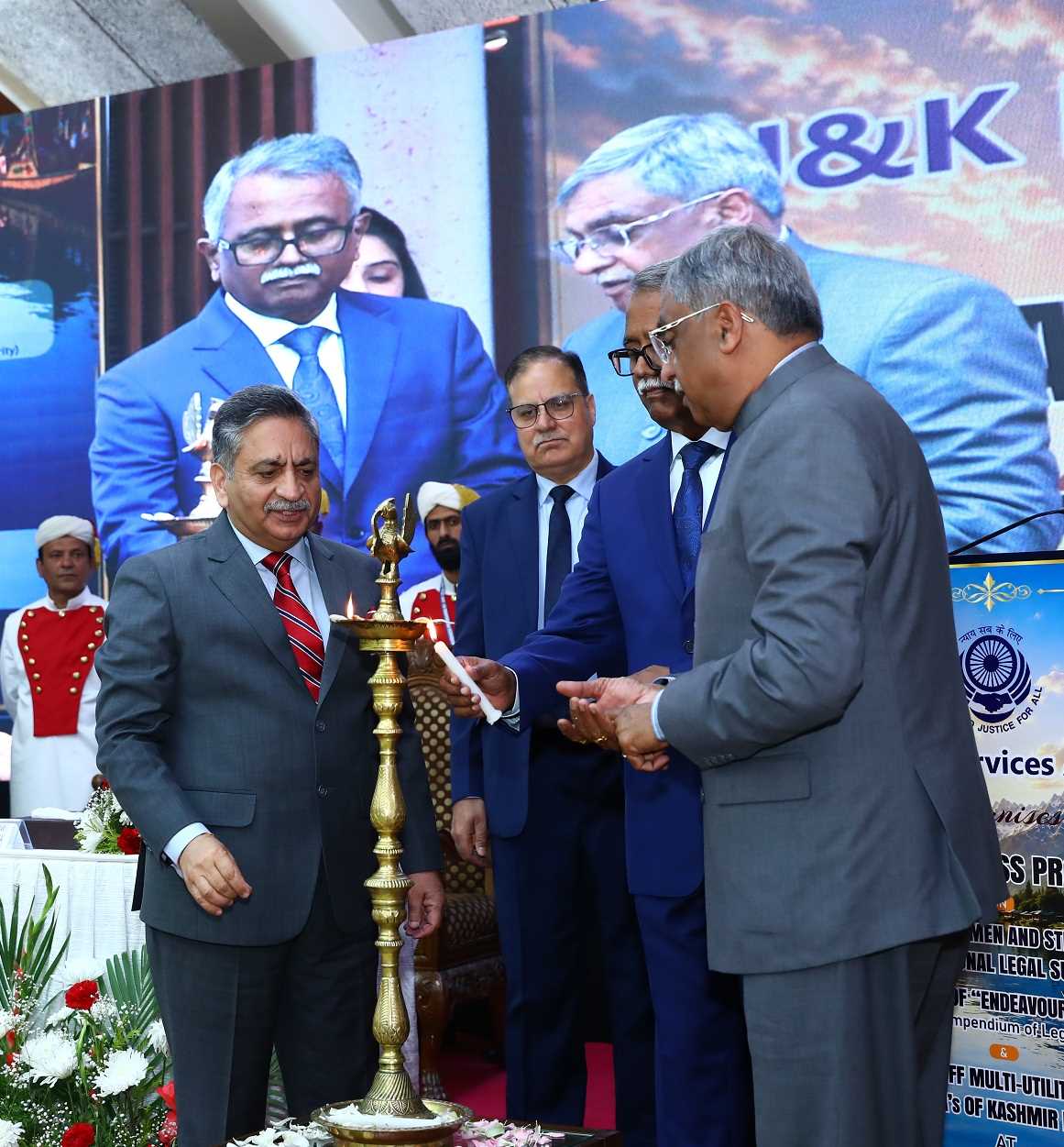
The Jammu and Kashmir Legal Services Authority under the guidance of National Legal Services Authority today organised a mega awareness programme on “Empowering Women and Strengthening Institutional Legal Support” at SKICC, Srinagar.
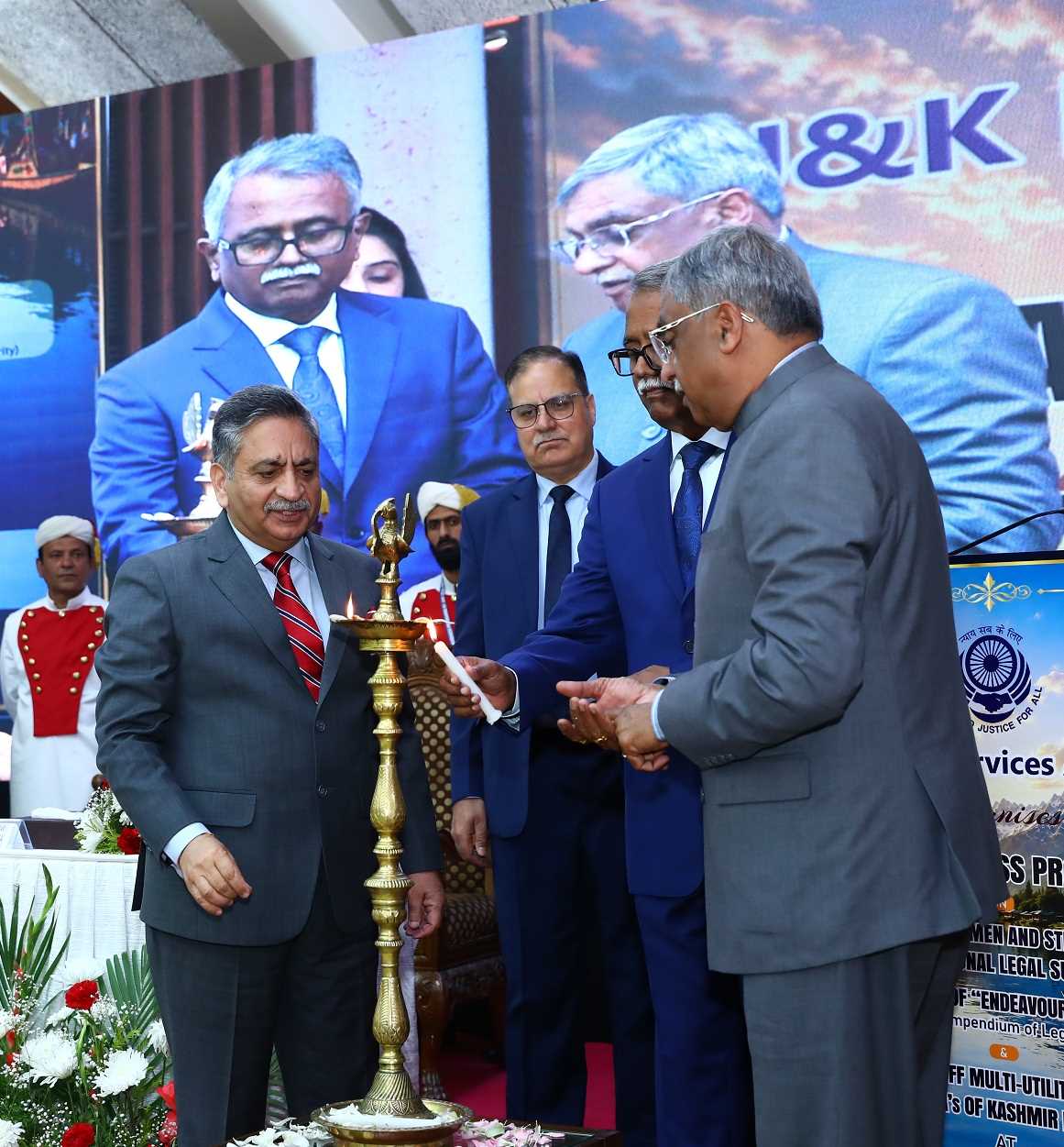
Among others present on the occasion were Justice Vikram Nath, Judge, Supreme Court of India and Executive Chairman, National Legal Services Authority; Justice S. V. N. Bhatti, Judge, Supreme Court of India and Supervising Judge for J&K Legal Services Authority; Justice Sanjeev Kumar, Chief Justice (Acting), High Court of Jammu & Kashmir and Ladakh and Executive Chairman, J&K Legal Services Authority; Justice Sanjay Dhar, Judge, High Court of J&K and Ladakh and Chairperson, High Legal Services Committee besides other Judges of the High Court of J&K and Ladakh.
The programme was conceived as a common institutional platform to strengthen awareness of the legal rights of women and girl children and to improve coordination among the Legal Services Institutions, Police, Health, Education, Social Welfare, One Stop Centres, Child Welfare Committees and other authorities responsible for protection, legal assistance, compensation, rehabilitation and follow-up support.
In his presidential address, Justice Vikram Nath, Judge, Supreme Court of India and Executive Chairman, NALSA, emphasized that the effectiveness of Legal Services Institutions must be judged by whether a person in distress is able to approach the system without fear, be heard with dignity and receive competent assistance without avoidable delay. He called upon all the stakeholders to strengthen the legal literacy, institutional coordination and grassroots outreach so that constitutional and statutory safeguards become a practical reality for women and girl children.
Justice Vikram Nath further stressed that the proceedings and key deliberations of this conference should be translated into vernacular languages and circulated among all concerned stakeholders, so that the knowledge and guidance emanating from the conference are easily understood and effectively acted upon at grassroots level.
Justice S. V. N. Bhatti, Judge, Supreme Court of India and Supervising Judge for the J&K Legal Services Authority, during his special address, highlighted the need for functional grievance mechanisms, trained stakeholders and victim-sensitive procedures. He observed that women and children should not be compelled to navigate a fragmented institutional system or repeatedly recount traumatic experiences before different authorities. Clear referral pathways, confidentiality and accountability, he stated, are necessary for meaningful legal empowerment.
While delivering the inaugural address, Justice Sanjeev Kumar, Chief Justice (Acting), High Court of J&K and Ladakh and Executive Chairman, J&K Legal Services Authority, underscored that access to justice cannot be measured merely by the availability of laws and institutions.
Justice Sanjeev Kumar called for stronger grassroots outreach and effective functioning of Front Offices, Legal Aid Clinics, Panel Lawyers and Para-Legal Volunteers so that persons in need are guided to appropriate remedies without procedural hardships. He also stressed the importance of convergence among all stakeholder institutions dealing with women in distress.
Recalling the distinguished tradition of humanitarian and justice-oriented intervention by the J&K Legal Services Authority, Justice Sanjeev Kumar highlighted its exemplary response in the aftermath of the devastating earthquake of 2005. The J&K Legal Services Authority undertook proactive measures to reach out to the affected population and facilitated timely settlement of their claims. In a significant departure from conventional court-based proceedings, Judicial Officers stepped beyond the confined traditional courtrooms and conducted Lok Adalats in the open, closer to the affected communities, enabling victims to receive compensation and have their claims settled on the spot.
Senior functionaries, including the General Managers of the concerned insurance companies, were brought together on a common platform so that insurance claims could be examined and settled expeditiously, thereby demonstrating how responsive, innovative and compassionate justice-delivery mechanisms can provide meaningful relief during times of crisis.
Justice Sanjay Dhar, Judge, High Court of J&K and Ladakh and Chairperson, High Court Legal Services Committee, in his address, observed that recognition of a right in law is only the beginning and that the real test of justice lies in whether the right can be understood, approached and effectively enforced.
Justice Sanjay Dhar emphasized that the constitutional character of the justice system is reflected in the manner in which a woman is received by the first institution she approaches. Prompt assistance, confidentiality, sensitivity and institutional follow-up, he said, are essential to prevent secondary victimisation and restore confidence in the justice system.
On the occasion, “ENDEAVOUR-2025”, the Annual Newsletter-cum-Compendium reflecting the legal services activities and initiatives undertaken across the Union Territory during the year 2025, was released by the dignitaries.
The awareness programme was also graced by the presence of Justice Sindhu Sharma, Justice Rajnesh Oswal, Justice Mohd. Akram Chowdhary, Justice Rahul Bharti, Justice Moksha Khajuria Kazmi, Justice Wasim Sadiq Nargal, Justice Rajesh Sekhri, Justice Mohd. Yousuf Wani, Justice Sanjay Parihar and Justice Shahzad Azeem.
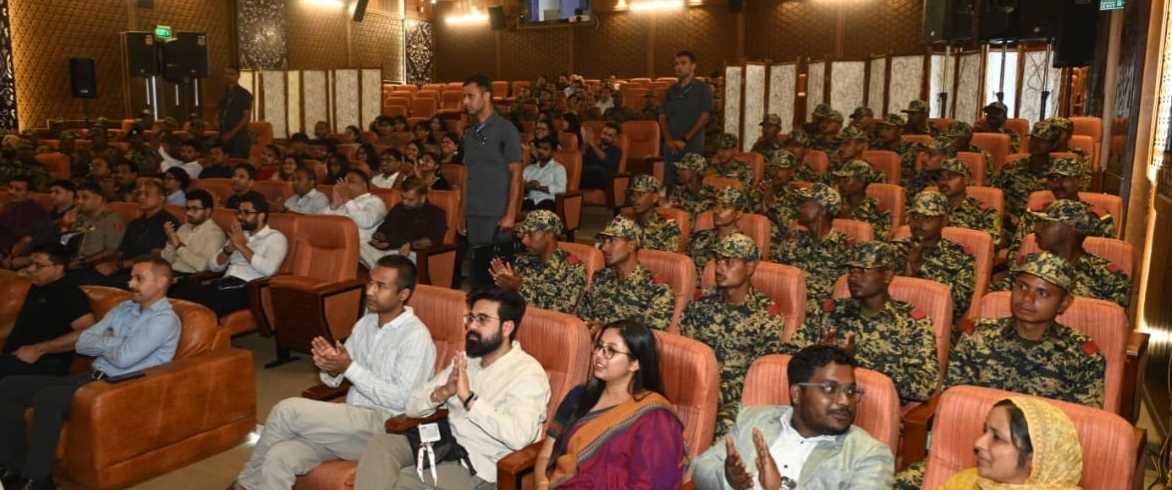
The programme was also attended by a Former Chief Justice and other former Judges of the High Court of J&K and Ladakh; officers of NALSA and the Registry of High Court of J&K and Ladakh; Judicial Officers; representatives of the Civil and Police Administration; academicians and representatives of various Government departments and institutions.
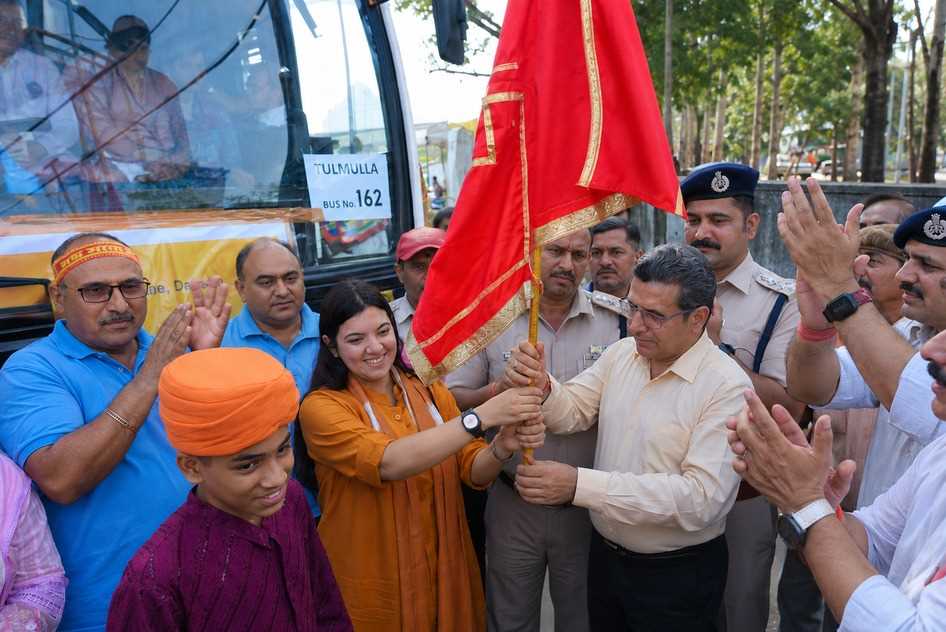
The dignitaries also flagged off Multi-Utility Vehicles for the District Legal Services Authorities of Kashmir Province. These vehicles will strengthen the mobile legal services and enable DLSAs to extend legal awareness and legal aid services to remote, far-flung and underserved areas.
The programme thereafter unfolded through two technical sessions. The first technical session, on the theme “Women’s Rights, Legal Empowerment and Access to Justice: Role of Legal Services Institutions”, was chaired by Justice Vikram Nath and co-chaired by Justice S. V. N. Bhatti. The session focused on the Sexual Harassment of Women at Workplace (Prevention, Prohibition and Redressal) Act, 2013, the Protection of Children from Sexual Offences Act, 2012 and the Medical Termination of Pregnancy Act, 1971.
The deliberations in the first session covered safe and dignified workplaces, constitution and effective functioning of Internal and Local Committees, child-friendly procedures under the POCSO Act, protection of identity and privacy, reproductive rights, bodily autonomy, confidentiality and timely access to lawful medical care. The role of Legal Services Authorities in creating awareness, facilitating early legal intervention and coordinating with first-response institutions was also discussed. The session concluded with remarks by Justice S. V. N. Bhatti, who stressed that statutory compliance must be substantive and not merely formal or paper-based.
The second technical session, on the theme “Institutional Support, Victim Assistance and Convergence Mechanisms for Women in Distress”, was chaired by Justice Sindhu Sharma, Judge, High Court of J&K and Ladakh and Executive Chairman, Ladakh Legal Services Authority and co-chaired by Justice Moksha Khajuria Kazmi, Judge, High Court of J&K and Ladakh.
While chairing the session, Justice Sindhu Sharma emphasized the need for a coordinated and compassionate institutional response that places the dignity, safety and rehabilitation of the survivor at the centre of every intervention.
Justice Sindhu Sharma stressed that effective convergence among Legal Services Institutions, police, medical authorities, welfare departments and other stakeholders is essential to ensure timely and comprehensive assistance to women in distress.
The technical resource persons emphasized that justice for a survivor cannot end with registration of a case or conclusion of trial and that medical care, counselling, legal representation, shelter, protection, compensation and rehabilitation may be required simultaneously.
The session also discussed cyberstalking, impersonation, misuse of images, online blackmail and technology-enabled abuse, with emphasis on prompt reporting, preservation of digital evidence, privacy and victim-sensitive handling of complaints.
In her concluding remarks, Justice Moksha Khajuria Kazmi underlined that convergence becomes meaningful only when responsibilities are clearly assigned, timelines are known and the victim is supported through a continuum of assistance.
The welcome address was presented by Shazia Tabasum, Member Secretary, J&K Legal Services Authority and the vote of thanks was delivered by Haq Nawaz Zargar, Principal District & Sessions Judge and Chairperson, District Legal Services Authority, Srinagar.

The Jammu and Kashmir Legal Services Authority under the guidance of National Legal Services Authority today organised a mega awareness programme on “Empowering Women and Strengthening Institutional Legal Support” at SKICC, Srinagar.
Among others present on the occasion were Justice Vikram Nath, Judge, Supreme Court of India and Executive Chairman, National Legal Services Authority; Justice S. V. N. Bhatti, Judge, Supreme Court of India and Supervising Judge for J&K Legal Services Authority; Justice Sanjeev Kumar, Chief Justice (Acting), High Court of Jammu & Kashmir and Ladakh and Executive Chairman, J&K Legal Services Authority; Justice Sanjay Dhar, Judge, High Court of J&K and Ladakh and Chairperson, High Legal Services Committee besides other Judges of the High Court of J&K and Ladakh.
The programme was conceived as a common institutional platform to strengthen awareness of the legal rights of women and girl children and to improve coordination among the Legal Services Institutions, Police, Health, Education, Social Welfare, One Stop Centres, Child Welfare Committees and other authorities responsible for protection, legal assistance, compensation, rehabilitation and follow-up support.
In his presidential address, Justice Vikram Nath, Judge, Supreme Court of India and Executive Chairman, NALSA, emphasized that the effectiveness of Legal Services Institutions must be judged by whether a person in distress is able to approach the system without fear, be heard with dignity and receive competent assistance without avoidable delay. He called upon all the stakeholders to strengthen the legal literacy, institutional coordination and grassroots outreach so that constitutional and statutory safeguards become a practical reality for women and girl children.
Justice Vikram Nath further stressed that the proceedings and key deliberations of this conference should be translated into vernacular languages and circulated among all concerned stakeholders, so that the knowledge and guidance emanating from the conference are easily understood and effectively acted upon at grassroots level.
Justice S. V. N. Bhatti, Judge, Supreme Court of India and Supervising Judge for the J&K Legal Services Authority, during his special address, highlighted the need for functional grievance mechanisms, trained stakeholders and victim-sensitive procedures. He observed that women and children should not be compelled to navigate a fragmented institutional system or repeatedly recount traumatic experiences before different authorities. Clear referral pathways, confidentiality and accountability, he stated, are necessary for meaningful legal empowerment.
While delivering the inaugural address, Justice Sanjeev Kumar, Chief Justice (Acting), High Court of J&K and Ladakh and Executive Chairman, J&K Legal Services Authority, underscored that access to justice cannot be measured merely by the availability of laws and institutions.
Justice Sanjeev Kumar called for stronger grassroots outreach and effective functioning of Front Offices, Legal Aid Clinics, Panel Lawyers and Para-Legal Volunteers so that persons in need are guided to appropriate remedies without procedural hardships. He also stressed the importance of convergence among all stakeholder institutions dealing with women in distress.
Recalling the distinguished tradition of humanitarian and justice-oriented intervention by the J&K Legal Services Authority, Justice Sanjeev Kumar highlighted its exemplary response in the aftermath of the devastating earthquake of 2005. The J&K Legal Services Authority undertook proactive measures to reach out to the affected population and facilitated timely settlement of their claims. In a significant departure from conventional court-based proceedings, Judicial Officers stepped beyond the confined traditional courtrooms and conducted Lok Adalats in the open, closer to the affected communities, enabling victims to receive compensation and have their claims settled on the spot.
Senior functionaries, including the General Managers of the concerned insurance companies, were brought together on a common platform so that insurance claims could be examined and settled expeditiously, thereby demonstrating how responsive, innovative and compassionate justice-delivery mechanisms can provide meaningful relief during times of crisis.
Justice Sanjay Dhar, Judge, High Court of J&K and Ladakh and Chairperson, High Court Legal Services Committee, in his address, observed that recognition of a right in law is only the beginning and that the real test of justice lies in whether the right can be understood, approached and effectively enforced.
Justice Sanjay Dhar emphasized that the constitutional character of the justice system is reflected in the manner in which a woman is received by the first institution she approaches. Prompt assistance, confidentiality, sensitivity and institutional follow-up, he said, are essential to prevent secondary victimisation and restore confidence in the justice system.
On the occasion, “ENDEAVOUR-2025”, the Annual Newsletter-cum-Compendium reflecting the legal services activities and initiatives undertaken across the Union Territory during the year 2025, was released by the dignitaries.
The awareness programme was also graced by the presence of Justice Sindhu Sharma, Justice Rajnesh Oswal, Justice Mohd. Akram Chowdhary, Justice Rahul Bharti, Justice Moksha Khajuria Kazmi, Justice Wasim Sadiq Nargal, Justice Rajesh Sekhri, Justice Mohd. Yousuf Wani, Justice Sanjay Parihar and Justice Shahzad Azeem.
The programme was also attended by a Former Chief Justice and other former Judges of the High Court of J&K and Ladakh; officers of NALSA and the Registry of High Court of J&K and Ladakh; Judicial Officers; representatives of the Civil and Police Administration; academicians and representatives of various Government departments and institutions.
The dignitaries also flagged off Multi-Utility Vehicles for the District Legal Services Authorities of Kashmir Province. These vehicles will strengthen the mobile legal services and enable DLSAs to extend legal awareness and legal aid services to remote, far-flung and underserved areas.
The programme thereafter unfolded through two technical sessions. The first technical session, on the theme “Women’s Rights, Legal Empowerment and Access to Justice: Role of Legal Services Institutions”, was chaired by Justice Vikram Nath and co-chaired by Justice S. V. N. Bhatti. The session focused on the Sexual Harassment of Women at Workplace (Prevention, Prohibition and Redressal) Act, 2013, the Protection of Children from Sexual Offences Act, 2012 and the Medical Termination of Pregnancy Act, 1971.
The deliberations in the first session covered safe and dignified workplaces, constitution and effective functioning of Internal and Local Committees, child-friendly procedures under the POCSO Act, protection of identity and privacy, reproductive rights, bodily autonomy, confidentiality and timely access to lawful medical care. The role of Legal Services Authorities in creating awareness, facilitating early legal intervention and coordinating with first-response institutions was also discussed. The session concluded with remarks by Justice S. V. N. Bhatti, who stressed that statutory compliance must be substantive and not merely formal or paper-based.
The second technical session, on the theme “Institutional Support, Victim Assistance and Convergence Mechanisms for Women in Distress”, was chaired by Justice Sindhu Sharma, Judge, High Court of J&K and Ladakh and Executive Chairman, Ladakh Legal Services Authority and co-chaired by Justice Moksha Khajuria Kazmi, Judge, High Court of J&K and Ladakh.
While chairing the session, Justice Sindhu Sharma emphasized the need for a coordinated and compassionate institutional response that places the dignity, safety and rehabilitation of the survivor at the centre of every intervention.
Justice Sindhu Sharma stressed that effective convergence among Legal Services Institutions, police, medical authorities, welfare departments and other stakeholders is essential to ensure timely and comprehensive assistance to women in distress.
The technical resource persons emphasized that justice for a survivor cannot end with registration of a case or conclusion of trial and that medical care, counselling, legal representation, shelter, protection, compensation and rehabilitation may be required simultaneously.
The session also discussed cyberstalking, impersonation, misuse of images, online blackmail and technology-enabled abuse, with emphasis on prompt reporting, preservation of digital evidence, privacy and victim-sensitive handling of complaints.
In her concluding remarks, Justice Moksha Khajuria Kazmi underlined that convergence becomes meaningful only when responsibilities are clearly assigned, timelines are known and the victim is supported through a continuum of assistance.
The welcome address was presented by Shazia Tabasum, Member Secretary, J&K Legal Services Authority and the vote of thanks was delivered by Haq Nawaz Zargar, Principal District & Sessions Judge and Chairperson, District Legal Services Authority, Srinagar.
© Copyright 2023 brighterkashmir.com All Rights Reserved. Quantum Technologies