
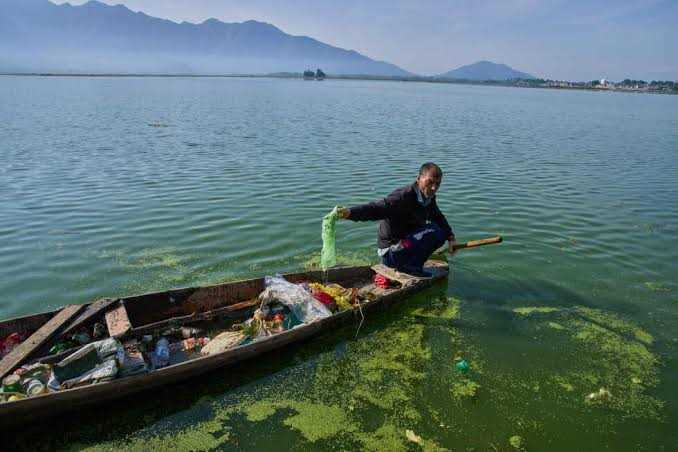
Srinagar, Aug 10: Fresh concerns have emerged over the deteriorating condition of Srinagar’s Dal Lake, with large stretches of water turning green, extensive weed growth reported across the lake and several fish allegedly found dead or in an unconscious state.
Shikarawalas and local residents have raised concerns over the deteriorating water quality and alleged that diesel leakage from machinery being used for mechanical de-weeding may be contributing to the problem.
The Lakes Conservation and Management Authority (LCMA) has deployed high-capacity machinery for removing aquatic weeds from the lake. However, some boatmen alleged that the machines were leaking diesel during operations, raising questions over the environmental impact of the de-weeding process.
“If machines being used to clean the lake are leaking diesel into the water, what kind of cleaning is this?” some shikarawalas questioned, pointing to the changing colour of the water and the reported fish deaths.
Boatmen claimed that hundreds of fish had recently been observed floating in the lake, with some appearing unconscious and others already dead. They called for an immediate scientific assessment to determine the actual cause of the reported deterioration and fish mortality.
Residents said the rapid spread of weeds and visible changes in the lake’s water quality were signs of growing ecological stress. They stressed that Dal Lake was not merely a tourist attraction but a vital natural ecosystem supporting aquatic life as well as the livelihoods of numerous families.
Concerns were also raised over the substantial expenditure incurred on the lake’s conservation and mechanical cleaning over the years. Previous official records and reports have documented significant spending on weed harvesters and other cleaning equipment, including an expenditure of Rs 25.15 crore on cleaning machines between 1997 and 2015.
However, the latest allegations require independent verification. Scientific testing of lake water and sediment could establish whether diesel, sewage, nutrients, algal growth or other pollutants are contributing to the reported changes and fish mortality.
Several shikarawalas have urged the Government to constitute an independent committee comprising environmental experts and other technical specialists to examine the lake’s present condition. They want the panel to assess water quality, aquatic health, de-weeding operations, the effectiveness of conservation measures and expenditure incurred over the years.
They also called for greater transparency in the implementation of Dal Lake conservation projects, arguing that repeated cleaning exercises would have limited impact unless the underlying causes of pollution and excessive weed growth were addressed.
For residents and boatmen, the issue goes beyond the lake’s appearance. Dal Lake remains central to Srinagar’s tourism economy and is an important part of Kashmir’s environmental and cultural heritage.
The immediate priority, they said, should be to establish the facts through an impartial scientific assessment and take corrective measures before the ecological condition of the iconic water body deteriorates further


Srinagar, Aug 10: Fresh concerns have emerged over the deteriorating condition of Srinagar’s Dal Lake, with large stretches of water turning green, extensive weed growth reported across the lake and several fish allegedly found dead or in an unconscious state.
Shikarawalas and local residents have raised concerns over the deteriorating water quality and alleged that diesel leakage from machinery being used for mechanical de-weeding may be contributing to the problem.
The Lakes Conservation and Management Authority (LCMA) has deployed high-capacity machinery for removing aquatic weeds from the lake. However, some boatmen alleged that the machines were leaking diesel during operations, raising questions over the environmental impact of the de-weeding process.
“If machines being used to clean the lake are leaking diesel into the water, what kind of cleaning is this?” some shikarawalas questioned, pointing to the changing colour of the water and the reported fish deaths.
Boatmen claimed that hundreds of fish had recently been observed floating in the lake, with some appearing unconscious and others already dead. They called for an immediate scientific assessment to determine the actual cause of the reported deterioration and fish mortality.
Residents said the rapid spread of weeds and visible changes in the lake’s water quality were signs of growing ecological stress. They stressed that Dal Lake was not merely a tourist attraction but a vital natural ecosystem supporting aquatic life as well as the livelihoods of numerous families.
Concerns were also raised over the substantial expenditure incurred on the lake’s conservation and mechanical cleaning over the years. Previous official records and reports have documented significant spending on weed harvesters and other cleaning equipment, including an expenditure of Rs 25.15 crore on cleaning machines between 1997 and 2015.
However, the latest allegations require independent verification. Scientific testing of lake water and sediment could establish whether diesel, sewage, nutrients, algal growth or other pollutants are contributing to the reported changes and fish mortality.
Several shikarawalas have urged the Government to constitute an independent committee comprising environmental experts and other technical specialists to examine the lake’s present condition. They want the panel to assess water quality, aquatic health, de-weeding operations, the effectiveness of conservation measures and expenditure incurred over the years.
They also called for greater transparency in the implementation of Dal Lake conservation projects, arguing that repeated cleaning exercises would have limited impact unless the underlying causes of pollution and excessive weed growth were addressed.
For residents and boatmen, the issue goes beyond the lake’s appearance. Dal Lake remains central to Srinagar’s tourism economy and is an important part of Kashmir’s environmental and cultural heritage.
The immediate priority, they said, should be to establish the facts through an impartial scientific assessment and take corrective measures before the ecological condition of the iconic water body deteriorates further

© Copyright 2023 brighterkashmir.com All Rights Reserved. Quantum Technologies