
BREAKING NEWS
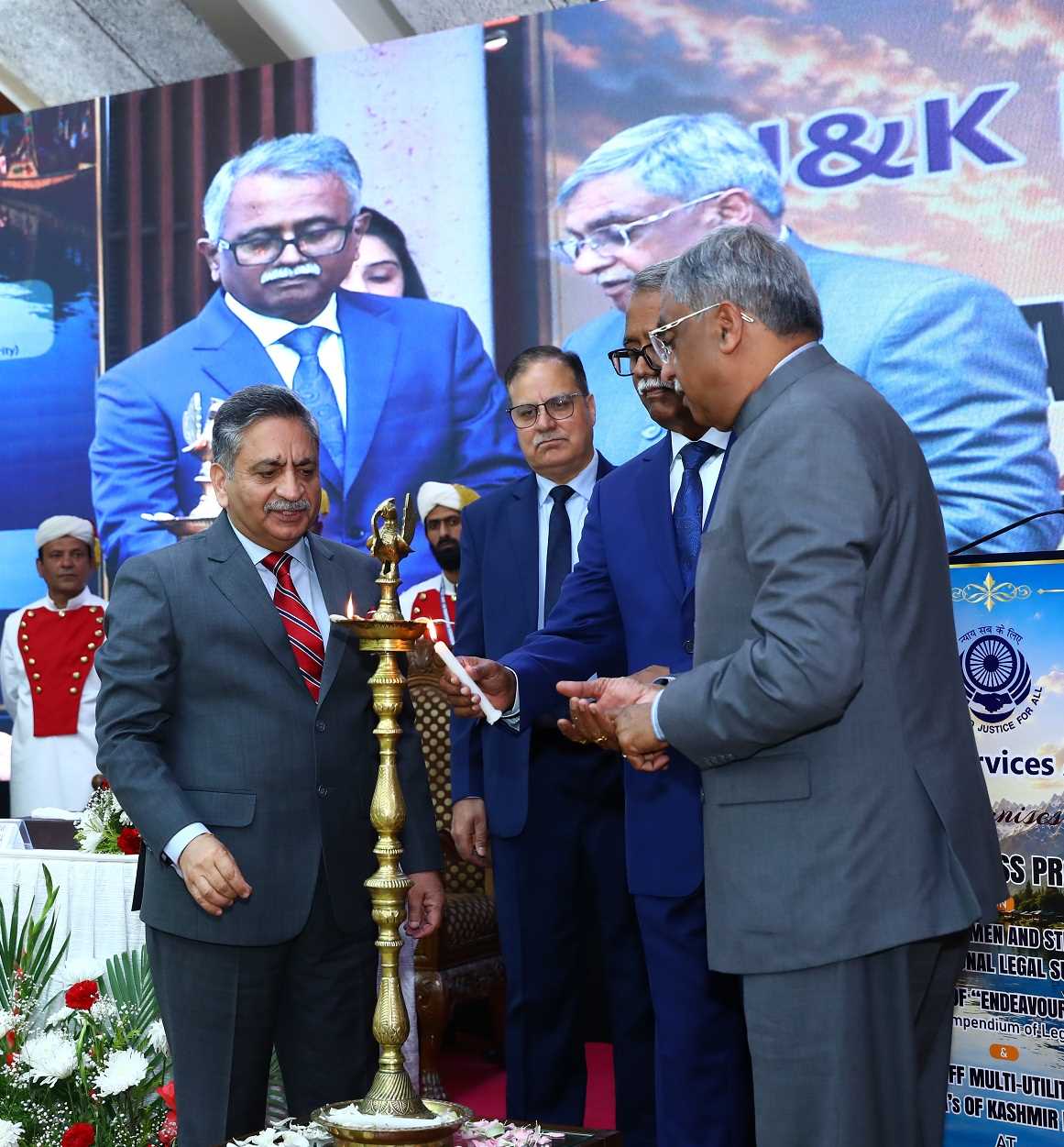
Srinagar, June 20: The Jammu and Kashmir Legal Services Authority (JKLSA), under the guidance of the National Legal Services Authority (NALSA), organised a mega awareness programme on “Empowering Women and Strengthening Institutional Legal Support” at SKICC, Srinagar.
The programme brought together judges of the Supreme Court of India and the High Court of J&K and Ladakh, along with senior judicial officers and officials from allied departments, to deliberate on improving access to justice for women and children.
In his address, Justice Vikram Nath, Judge, Supreme Court of India and Executive Chairman, NALSA, stressed that legal services institutions must ensure that persons in distress can approach the justice system without fear, are heard with dignity, and receive timely legal assistance. He called for stronger legal literacy, grassroots outreach, and wider dissemination of legal awareness in local languages.
Justice S.V.N. Bhatti emphasized the need for efficient grievance redress mechanisms and victim-sensitive procedures, noting that survivors should not be subjected to repeated trauma while navigating fragmented systems. He underlined the importance of confidentiality, coordination, and clear institutional pathways.
Justice Sanjeev Kumar, Chief Justice (Acting), High Court of J&K and Ladakh, highlighted that access to justice goes beyond laws and institutions and depends on effective frontline legal aid mechanisms. He also recalled the proactive role of JKLSA during the 2005 earthquake, when Lok Adalats were held in affected areas to ensure swift compensation and relief.
Justice Sanjay Dhar stressed that legal rights must be matched with effective enforcement mechanisms and sensitive institutional response, particularly at the first point of contact for women seeking justice.
The programme featured two technical sessions focusing on women’s rights, legal empowerment, workplace safety laws, child protection, reproductive rights, and victim assistance frameworks. Experts also discussed cyberstalking, digital abuse, and the need for prompt preservation of electronic evidence.
Speakers highlighted the importance of convergence among legal, police, health, and welfare institutions to ensure comprehensive support covering legal aid, medical care, counselling, protection, and rehabilitation.
On the occasion, dignitaries released “ENDEAVOUR-2025”, the annual newsletter of legal services activities in Jammu and Kashmir, and flagged off Multi-Utility Vehicles for District Legal Services Authorities to strengthen mobile legal aid outreach in remote areas.
The programme concluded with a consensus that justice delivery systems must remain accessible, coordinated, and survivor-centric to ensure meaningful legal empowerment for women and children.
Srinagar, June 20: The Jammu and Kashmir Legal Services Authority (JKLSA), under the guidance of the National Legal Services Authority (NALSA), organised a mega awareness programme on “Empowering Women and Strengthening Institutional Legal Support” at SKICC, Srinagar.
The programme brought together judges of the Supreme Court of India and the High Court of J&K and Ladakh, along with senior judicial officers and officials from allied departments, to deliberate on improving access to justice for women and children.
In his address, Justice Vikram Nath, Judge, Supreme Court of India and Executive Chairman, NALSA, stressed that legal services institutions must ensure that persons in distress can approach the justice system without fear, are heard with dignity, and receive timely legal assistance. He called for stronger legal literacy, grassroots outreach, and wider dissemination of legal awareness in local languages.
Justice S.V.N. Bhatti emphasized the need for efficient grievance redress mechanisms and victim-sensitive procedures, noting that survivors should not be subjected to repeated trauma while navigating fragmented systems. He underlined the importance of confidentiality, coordination, and clear institutional pathways.
Justice Sanjeev Kumar, Chief Justice (Acting), High Court of J&K and Ladakh, highlighted that access to justice goes beyond laws and institutions and depends on effective frontline legal aid mechanisms. He also recalled the proactive role of JKLSA during the 2005 earthquake, when Lok Adalats were held in affected areas to ensure swift compensation and relief.
Justice Sanjay Dhar stressed that legal rights must be matched with effective enforcement mechanisms and sensitive institutional response, particularly at the first point of contact for women seeking justice.
The programme featured two technical sessions focusing on women’s rights, legal empowerment, workplace safety laws, child protection, reproductive rights, and victim assistance frameworks. Experts also discussed cyberstalking, digital abuse, and the need for prompt preservation of electronic evidence.
Speakers highlighted the importance of convergence among legal, police, health, and welfare institutions to ensure comprehensive support covering legal aid, medical care, counselling, protection, and rehabilitation.
On the occasion, dignitaries released “ENDEAVOUR-2025”, the annual newsletter of legal services activities in Jammu and Kashmir, and flagged off Multi-Utility Vehicles for District Legal Services Authorities to strengthen mobile legal aid outreach in remote areas.
The programme concluded with a consensus that justice delivery systems must remain accessible, coordinated, and survivor-centric to ensure meaningful legal empowerment for women and children.

© Copyright 2023 brighterkashmir.com All Rights Reserved. Quantum Technologies