
BREAKING NEWS
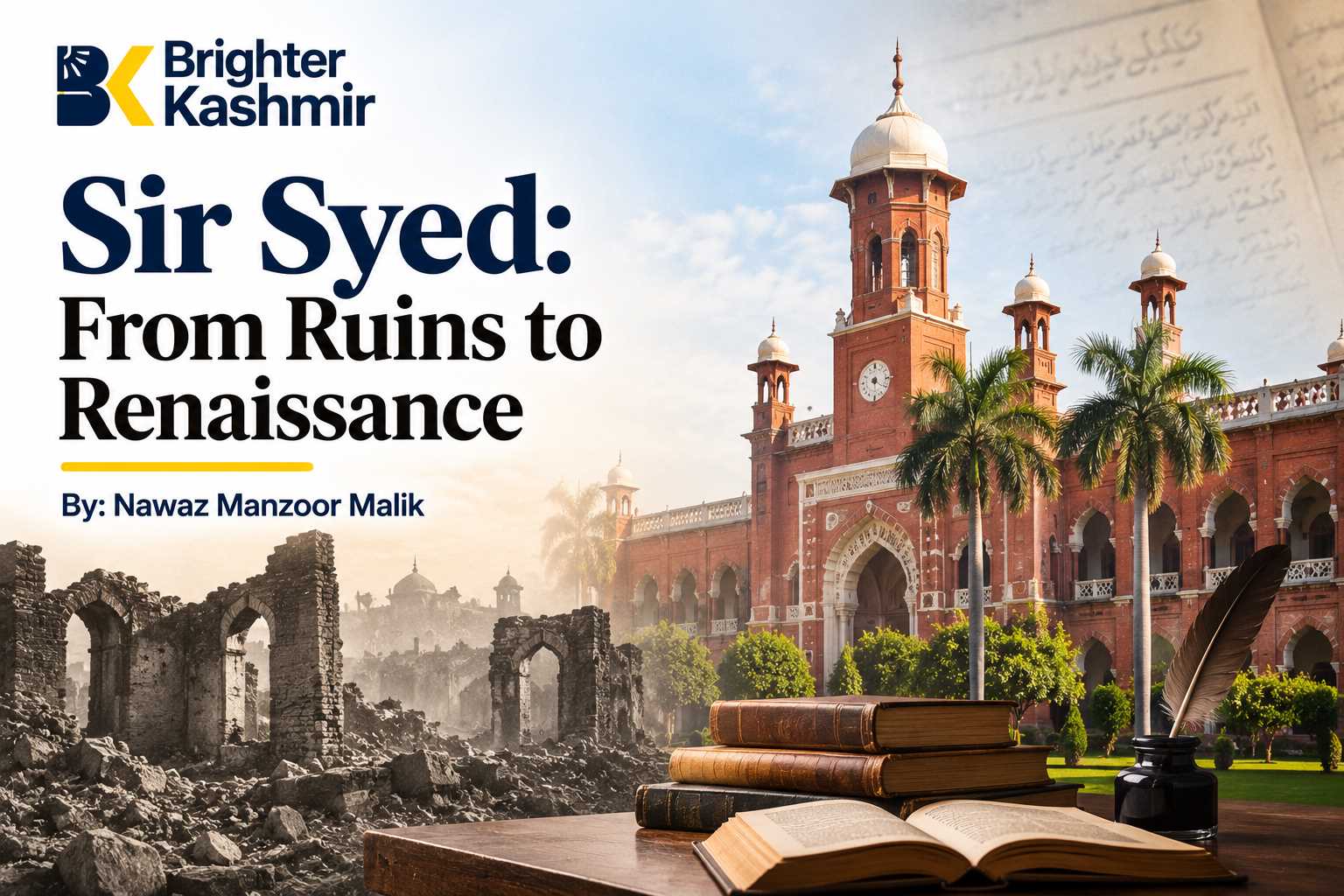
Syed was in Bijnor as Sadr Amin when the revolt of 1857 erupted. What he saw changed his life forever. He saw Delhi - his Delhi - burned, looted, and its Muslims massacred and hunted by the British
When we read the history of India after 1857, we usually read about a lost war. Sir Syed Ahmad Khan read something else - he read about a lost future. And he decided to rebuild it.
The Birth of a Witness - 1817 to 1836
Born on 17th October 1817 in Delhi, Syed Ahmad Khan was not born poor. He was born into the nobility of the dying Mughal Empire. His maternal grandfather, Khwaja Fariduddin, was a former Prime Minister of the Mughal court. His father, Syed Muttaqi, was close to Emperor Akbar Shah II. Young Syed grew up seeing two worlds in one house. Inside, Mughal etiquette, Persian poetry, and Islamic theology. Outside, the rising power of the British East India Company with its English schools, its courts, its new power. This duality shaped him. He was not a Maulvi who rejected the West, nor an Englishman who rejected the East. He became a bridge. His father died in 1838, leaving the family in financial crisis. At 21, Sir Syed had to leave his comfortable studies and take a job as a clerk - Sarishtedar - in the British judicial service. It was a humiliation for a noble family, but it was his first lesson in modern reality: lineage will not feed you, education will.
1857: The Year That Broke India and Made Sir Syed
Sir Syed was in Bijnor as Sadr Amin when the revolt of 1857 erupted. What he saw changed his life forever. He saw Delhi - his Delhi - burned, looted, and its Muslims massacred and hunted by the British. His own uncle, his cousins were killed. His house was looted. His mother died in distress while hiding. And he did something rare - he saved British lives. He saved the lives of 20 British men, women and children in Bijnor at the risk of his own life.
Why? Not because he was a British loyalist. But because he believed in humanity over revenge. And because he understood one thing that no one else in 1857 understood:
The British were not going to leave. And if Muslims continued to hate them and avoid them, Muslims would be erased from India's future. After 1857, the British declared Muslims as the main culprits. Hindus went into British schools, learned English, and got jobs in the administration. Muslims, out of anger and religious fear, declared English education as _Haram_ and stayed in madrasas. The result was economic and intellectual death. Sir Syed wrote his famous book, *Asbab-e-Baghavat-e-Hind [The Causes of the Indian Revolt]* in 1859. In it, he boldly told the British: _You are the reason for this revolt. Because you never listened to Indians. It was an act of incredible courage to criticize your rulers just after they had crushed a revolt.
To save his community, Sir Syed had to fight three wars simultaneously.
War 1: Against the British - To prove Muslims are not traitors
He wrote _The Loyal Mohammedans of India_ and showed how Muslims had saved British lives. He founded the British Indian Association and demanded Indian representation.
War 2: Against Orthodox Mullahs - To prove modern education is not against Islam.
This was his hardest war. The clerics of Deoband called him a _Kafir_ (infidel), _Nasara_ (Christian agent). They issued fatwas against him. His answer was brilliant. He started interpreting Islam rationally. He said, "The Quran is the word of God, and Nature is the work of God. How can the work contradict the word?" Therefore, science cannot be against Islam. He wrote his _Tafsir-e-Quran_ based on science and reason. He founded his journal _Tehzeeb-ul-Akhlaq_ [The Refinement of Morals] to modernize Muslim thought. *War 3: Against Muslims Themselves - Their own inertia.*
He traveled to England in 1869-70 with his son. For the first time, he saw Oxford and Cambridge. He wept. He said, "If my community does not have this, they will have nothing." He saw electricity, printing presses, women studying. And he returned with a fire.
The Dream Called Aligarh
On 24th May 1875, on a small piece of land in Aligarh, he laid the foundation of *Madrasatul Uloom Musalmanan-e-Hind*. This became the *Muhammadan Anglo-Oriental College in 1877 and finally *Aligarh Muslim University* in 1920, after his death.
People think AMU is a building. It was a revolution. What Sir Syed did was unprecedented:
1.He created the first residential modern university for Indians.* On the Oxford model - students living together, debating, eating, learning brotherhood. Hindus, Muslims, all were welcome.
He combined East and West.* In the same campus, Quran was taught and Newton was taught. Arabic and English were taught together.
He made Muslims pay for it.* He didn't beg the British. He went door to door, collecting one rupee, two rupees from poor Muslims, carriage drivers, craftsmen. He made the community own its future. That is why AMU is called ‘’ Apni University’’.
Lord Lytton laid the foundation stone, but the soul was Sir Syed's.
The Most Forgotten Battle: Sir Syed and Women Empowerment. History books forget this. Sir Syed was the FIRST major Muslim reformer to speak openly for women's education at a time when even talking about it was taboo.
In _Tehzeeb-ul-Akhlaq_, he wrote: "When a mother is educated, the whole generation is educated. When a mother is ignorant, the whole generation remains ignorant." He was deeply hurt that Muslim girls were denied education. He argued that Islam's first wife, Hazrat Khadija, was a businesswoman, and Hazrat Aisha was a scholar who taught hundreds of male companions. So how can Islam be against women's education? He proposed that women should be educated not just in religion but in modern subjects, mathematics, and science - but within a respectable framework that his society would accept. He inspired Shaikh Abdullah and his wife Waheeda to start the first girls' school in Aligarh, which later became the Women's College of AMU.
If Sir Syed was only about men's education, AMU would be half of what it is today. His vision included women as builders of the nation.
His Philosophy: The True Meaning of Modern Education
Sir Syed didn't want to create clerks for the British. He wanted to create thinkers.
He gave three principles:
a) Scientific Temper:* Don't believe because someone said it. Question, observe, test. He was influenced by 19th-century science.
b) Character over Degree:* He said, "The first purpose of our college is to build character. If character is lost, everything is lost."
c) Empowerment, not slavery:* Education should make you independent, not a beggar for government jobs. It should make you stand on your feet. After 1857, India was politically enslaved. Sir Syed understood that a political revolution without an educational revolution is temporary. Real freedom comes from the mind.
Sir Syed died on 27th March 1898 in Aligarh. He is buried in the courtyard of the Jama Masjid of AMU, so that his students walk past him every day. He did not see AMU become a full university. He did not see his dream fully fulfilled. He died in debt because he spent all his pension and money on the college. But he won. Because today, when a girl from a small village in Kashmir or Kerala goes to a laboratory and does research, Sir Syed is alive. When a Muslim boy debates in English and recites Ghalib in the same breath, Sir Syed is alive. He was called "the Prophet of Modern Education" by many. But he was more than that. He was a man who turned the trauma of 1857 into a university.
In the ashes of Delhi, he planted a seed in Aligarh. And that seed is still growing.
The writer is the student of Aligarh Muslim University from the department of Political Science
Email:-------------------------nawazmanzoor71@gmail.Com
Syed was in Bijnor as Sadr Amin when the revolt of 1857 erupted. What he saw changed his life forever. He saw Delhi - his Delhi - burned, looted, and its Muslims massacred and hunted by the British
When we read the history of India after 1857, we usually read about a lost war. Sir Syed Ahmad Khan read something else - he read about a lost future. And he decided to rebuild it.
The Birth of a Witness - 1817 to 1836
Born on 17th October 1817 in Delhi, Syed Ahmad Khan was not born poor. He was born into the nobility of the dying Mughal Empire. His maternal grandfather, Khwaja Fariduddin, was a former Prime Minister of the Mughal court. His father, Syed Muttaqi, was close to Emperor Akbar Shah II. Young Syed grew up seeing two worlds in one house. Inside, Mughal etiquette, Persian poetry, and Islamic theology. Outside, the rising power of the British East India Company with its English schools, its courts, its new power. This duality shaped him. He was not a Maulvi who rejected the West, nor an Englishman who rejected the East. He became a bridge. His father died in 1838, leaving the family in financial crisis. At 21, Sir Syed had to leave his comfortable studies and take a job as a clerk - Sarishtedar - in the British judicial service. It was a humiliation for a noble family, but it was his first lesson in modern reality: lineage will not feed you, education will.
1857: The Year That Broke India and Made Sir Syed
Sir Syed was in Bijnor as Sadr Amin when the revolt of 1857 erupted. What he saw changed his life forever. He saw Delhi - his Delhi - burned, looted, and its Muslims massacred and hunted by the British. His own uncle, his cousins were killed. His house was looted. His mother died in distress while hiding. And he did something rare - he saved British lives. He saved the lives of 20 British men, women and children in Bijnor at the risk of his own life.
Why? Not because he was a British loyalist. But because he believed in humanity over revenge. And because he understood one thing that no one else in 1857 understood:
The British were not going to leave. And if Muslims continued to hate them and avoid them, Muslims would be erased from India's future. After 1857, the British declared Muslims as the main culprits. Hindus went into British schools, learned English, and got jobs in the administration. Muslims, out of anger and religious fear, declared English education as _Haram_ and stayed in madrasas. The result was economic and intellectual death. Sir Syed wrote his famous book, *Asbab-e-Baghavat-e-Hind [The Causes of the Indian Revolt]* in 1859. In it, he boldly told the British: _You are the reason for this revolt. Because you never listened to Indians. It was an act of incredible courage to criticize your rulers just after they had crushed a revolt.
To save his community, Sir Syed had to fight three wars simultaneously.
War 1: Against the British - To prove Muslims are not traitors
He wrote _The Loyal Mohammedans of India_ and showed how Muslims had saved British lives. He founded the British Indian Association and demanded Indian representation.
War 2: Against Orthodox Mullahs - To prove modern education is not against Islam.
This was his hardest war. The clerics of Deoband called him a _Kafir_ (infidel), _Nasara_ (Christian agent). They issued fatwas against him. His answer was brilliant. He started interpreting Islam rationally. He said, "The Quran is the word of God, and Nature is the work of God. How can the work contradict the word?" Therefore, science cannot be against Islam. He wrote his _Tafsir-e-Quran_ based on science and reason. He founded his journal _Tehzeeb-ul-Akhlaq_ [The Refinement of Morals] to modernize Muslim thought. *War 3: Against Muslims Themselves - Their own inertia.*
He traveled to England in 1869-70 with his son. For the first time, he saw Oxford and Cambridge. He wept. He said, "If my community does not have this, they will have nothing." He saw electricity, printing presses, women studying. And he returned with a fire.
The Dream Called Aligarh
On 24th May 1875, on a small piece of land in Aligarh, he laid the foundation of *Madrasatul Uloom Musalmanan-e-Hind*. This became the *Muhammadan Anglo-Oriental College in 1877 and finally *Aligarh Muslim University* in 1920, after his death.
People think AMU is a building. It was a revolution. What Sir Syed did was unprecedented:
1.He created the first residential modern university for Indians.* On the Oxford model - students living together, debating, eating, learning brotherhood. Hindus, Muslims, all were welcome.
He combined East and West.* In the same campus, Quran was taught and Newton was taught. Arabic and English were taught together.
He made Muslims pay for it.* He didn't beg the British. He went door to door, collecting one rupee, two rupees from poor Muslims, carriage drivers, craftsmen. He made the community own its future. That is why AMU is called ‘’ Apni University’’.
Lord Lytton laid the foundation stone, but the soul was Sir Syed's.
The Most Forgotten Battle: Sir Syed and Women Empowerment. History books forget this. Sir Syed was the FIRST major Muslim reformer to speak openly for women's education at a time when even talking about it was taboo.
In _Tehzeeb-ul-Akhlaq_, he wrote: "When a mother is educated, the whole generation is educated. When a mother is ignorant, the whole generation remains ignorant." He was deeply hurt that Muslim girls were denied education. He argued that Islam's first wife, Hazrat Khadija, was a businesswoman, and Hazrat Aisha was a scholar who taught hundreds of male companions. So how can Islam be against women's education? He proposed that women should be educated not just in religion but in modern subjects, mathematics, and science - but within a respectable framework that his society would accept. He inspired Shaikh Abdullah and his wife Waheeda to start the first girls' school in Aligarh, which later became the Women's College of AMU.
If Sir Syed was only about men's education, AMU would be half of what it is today. His vision included women as builders of the nation.
His Philosophy: The True Meaning of Modern Education
Sir Syed didn't want to create clerks for the British. He wanted to create thinkers.
He gave three principles:
a) Scientific Temper:* Don't believe because someone said it. Question, observe, test. He was influenced by 19th-century science.
b) Character over Degree:* He said, "The first purpose of our college is to build character. If character is lost, everything is lost."
c) Empowerment, not slavery:* Education should make you independent, not a beggar for government jobs. It should make you stand on your feet. After 1857, India was politically enslaved. Sir Syed understood that a political revolution without an educational revolution is temporary. Real freedom comes from the mind.
Sir Syed died on 27th March 1898 in Aligarh. He is buried in the courtyard of the Jama Masjid of AMU, so that his students walk past him every day. He did not see AMU become a full university. He did not see his dream fully fulfilled. He died in debt because he spent all his pension and money on the college. But he won. Because today, when a girl from a small village in Kashmir or Kerala goes to a laboratory and does research, Sir Syed is alive. When a Muslim boy debates in English and recites Ghalib in the same breath, Sir Syed is alive. He was called "the Prophet of Modern Education" by many. But he was more than that. He was a man who turned the trauma of 1857 into a university.
In the ashes of Delhi, he planted a seed in Aligarh. And that seed is still growing.
The writer is the student of Aligarh Muslim University from the department of Political Science
Email:-------------------------nawazmanzoor71@gmail.Com

© Copyright 2023 brighterkashmir.com All Rights Reserved. Quantum Technologies