
BREAKING NEWS
Muslims should attend RSS programmes just as RSS members participate in Muslim events: Mumbai’s Grand Mufti Manzoor Zayee
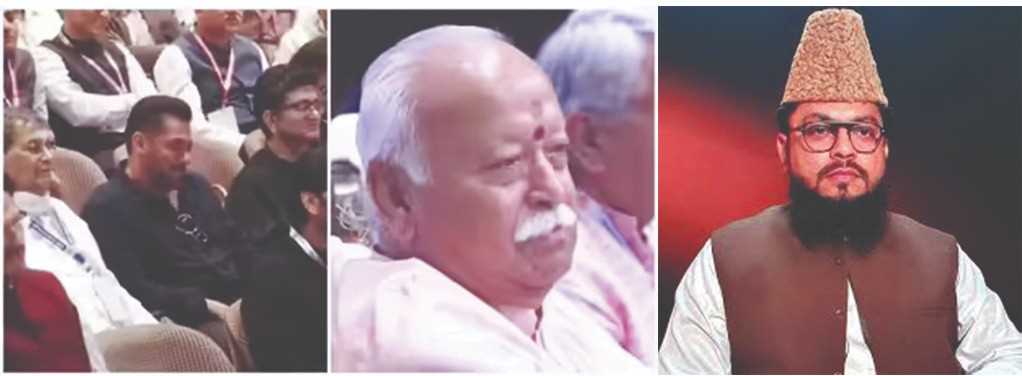
Mumbai, Feb 10: As the Rashtriya Swayamsevak Sangh (RSS) marks 100 years of its journey, a series of centenary events are being organised by the organisation across the country. One such high-profile event held in Mumbai drew widespread national attention, largely due to the presence of Bollywood superstar Salman Khan.
Khan’s attendance at the event organised as part of the RSS’s centenary lecture series, quickly became the focal point of political and social debate.
While several prominent personalities were present, Salman Khan—being a Muslim attending an RSS function drew the widespread attention.
During the event, RSS chief Mohan Bhagwat praised Salman Khan as a youth icon, noting his influence on young Indians who emulate his style and personality.
Khan was seen listening attentively throughout the proceedings but did not make any public statement.
The critics questioned Khan’s participation, asking whether it was a matter of “coercion or conviction.”
Social media soon amplified the debate, with critics suggesting the move was an attempt to soften the RSS’s Hindu nationalist image, while supporters described it as a sincere effort to promote dialogue and national unity.
The episode highlighted India’s deep cultural and political divisions, reigniting discussions around nationalism, secularism, and identity.
Mumbai’s Grand Mufti, Manzoor Zayee, welcomed Salman Khan’s participation and strongly defended interfaith engagement. He stated that Muslims should attend RSS programmes just as RSS members should participate in Muslim community events.
Emphasising national unity, Zayee said such gestures strengthen brotherhood and communal harmony, adding that “we all belong to one nation.”
According to sources familiar with the Sangh’s functioning, the objective of the centenary lecture series is to reach out to sections of society unfamiliar with RSS activities.
“Those who already understand the Sangh do not need convincing. The aim is to broaden outreach during this milestone year. Inviting film personalities was part of that effort,” they said.
The series, led by Mohan Bhagwat, brings together diverse voices—including film stars, scientists, diplomats, and social leaders—to explain the RSS’s journey and vision for nation-building. It also focuses on fostering a sense of belonging, promoting social harmony, and encouraging women’s leadership.
The RSS has also been engaged in structured dialogue with Muslim communities for several years through affiliated organisations such as the Muslim Rashtriya Manch, emphasising engagement over confrontation to reduce communal tensions.
Salman Khan’s presence has undeniably reignited conversations on inclusion, dialogue, and coexistence—issues that remain central to India’s social and political discourse.
Muslims should attend RSS programmes just as RSS members participate in Muslim events: Mumbai’s Grand Mufti Manzoor Zayee
Mumbai, Feb 10: As the Rashtriya Swayamsevak Sangh (RSS) marks 100 years of its journey, a series of centenary events are being organised by the organisation across the country. One such high-profile event held in Mumbai drew widespread national attention, largely due to the presence of Bollywood superstar Salman Khan.
Khan’s attendance at the event organised as part of the RSS’s centenary lecture series, quickly became the focal point of political and social debate.
While several prominent personalities were present, Salman Khan—being a Muslim attending an RSS function drew the widespread attention.
During the event, RSS chief Mohan Bhagwat praised Salman Khan as a youth icon, noting his influence on young Indians who emulate his style and personality.
Khan was seen listening attentively throughout the proceedings but did not make any public statement.
The critics questioned Khan’s participation, asking whether it was a matter of “coercion or conviction.”
Social media soon amplified the debate, with critics suggesting the move was an attempt to soften the RSS’s Hindu nationalist image, while supporters described it as a sincere effort to promote dialogue and national unity.
The episode highlighted India’s deep cultural and political divisions, reigniting discussions around nationalism, secularism, and identity.
Mumbai’s Grand Mufti, Manzoor Zayee, welcomed Salman Khan’s participation and strongly defended interfaith engagement. He stated that Muslims should attend RSS programmes just as RSS members should participate in Muslim community events.
Emphasising national unity, Zayee said such gestures strengthen brotherhood and communal harmony, adding that “we all belong to one nation.”
According to sources familiar with the Sangh’s functioning, the objective of the centenary lecture series is to reach out to sections of society unfamiliar with RSS activities.
“Those who already understand the Sangh do not need convincing. The aim is to broaden outreach during this milestone year. Inviting film personalities was part of that effort,” they said.
The series, led by Mohan Bhagwat, brings together diverse voices—including film stars, scientists, diplomats, and social leaders—to explain the RSS’s journey and vision for nation-building. It also focuses on fostering a sense of belonging, promoting social harmony, and encouraging women’s leadership.
The RSS has also been engaged in structured dialogue with Muslim communities for several years through affiliated organisations such as the Muslim Rashtriya Manch, emphasising engagement over confrontation to reduce communal tensions.
Salman Khan’s presence has undeniably reignited conversations on inclusion, dialogue, and coexistence—issues that remain central to India’s social and political discourse.

© Copyright 2023 brighterkashmir.com All Rights Reserved. Quantum Technologies