
BREAKING NEWS
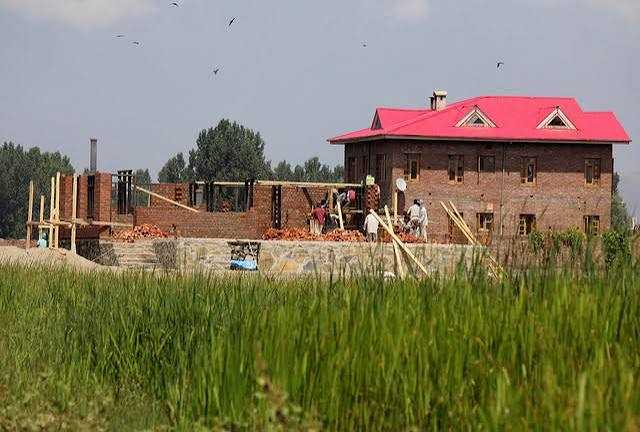
Srinagar, Sep 18: Kashmir’s rapidly changing landscape is raising concerns over the steady conversion of agricultural land into residential and commercial settlements, with wetlands, water channels and grazing areas also facing growing pressure.
For Mohammad Aijaz Parray of Zainakote, near Srinagar’s Hokersar wetland, the change is visible around his neighbourhood, where farmland has increasingly been replaced by houses and other structures.
Parray, who owns three acres and has chosen not to sell, said large stretches of agricultural land in the area have been converted into residential colonies since 1989.
The trend extends beyond Srinagar. Across Kashmir, expanding settlements, infrastructure and changing economic patterns are steadily altering the traditional rural landscape.
A 2026 study published in Water Science, examining land-use and land-cover changes in Jammu and Kashmir between 1960 and 2020, found a significant expansion of built-up areas, particularly after 1990, alongside declines in forests, pasture and grazing land and water bodies.
Researchers from SKUAST-Kashmir and Symbiosis Statistical Institute analysed six land categories and 13 climatic and socioeconomic factors. The study linked the changing landscape to population growth, urbanisation, infrastructure expansion, transport activity and economic development.
Jammu and Kashmir’s population increased from 0.35 crore in 1960 to 1.36 crore in 2020, while urbanisation rose from 16.3 per cent to 29.4 per cent and literacy from 11 per cent to 76.9 per cent.
For farmers, rising land values and limited agricultural returns have added to the pressure.
Ganderbal farmer Irfan Ahmad Tantray said much of the farmland he remembers from his childhood has been replaced by residential construction.
In Pattan, Baramulla, farmer Ghulam Nabi Bhat said inadequate irrigation and weak returns from traditional crops have made land conversion increasingly attractive to farming families.
The study also records a long-term decline in water-body extent, with population growth and urbanisation identified among the factors associated with the change.
Kashmir’s wetlands play a crucial role in supporting biodiversity, fisheries and agriculture while acting as natural buffers during heavy rainfall.
Environmentalists have warned that encroachment, filling and unplanned construction are weakening these ecological functions.
Shakil Romshoo, environmentalist and Vice Chancellor of IUST, said wetlands around Srinagar have faced sustained encroachment over several decades. He also highlighted pressures on Wular Lake, including sedimentation, which have affected its capacity to accommodate excess water.
A 2018 report of the J&K Legislative Assembly’s Environment Committee had noted that around 22 wetlands in and around Srinagar had been converted into residential colonies over five decades.
The issue remains under legislative consideration, with a Private Member’s Resolution moved by Budgam MLA Aga Syed Muntazir Mehdi on Hokersar Wetland admitted for discussion. It seeks examination of the wetland’s present and historical extent and adjoining residential and agricultural areas.
The study also points to declining pasture and grazing lands, highlighting a wider challenge for Kashmir: balancing urban expansion and economic development with the farmland and natural ecosystems that remain vital to the Valley’s future.
Srinagar, Sep 18: Kashmir’s rapidly changing landscape is raising concerns over the steady conversion of agricultural land into residential and commercial settlements, with wetlands, water channels and grazing areas also facing growing pressure.
For Mohammad Aijaz Parray of Zainakote, near Srinagar’s Hokersar wetland, the change is visible around his neighbourhood, where farmland has increasingly been replaced by houses and other structures.
Parray, who owns three acres and has chosen not to sell, said large stretches of agricultural land in the area have been converted into residential colonies since 1989.
The trend extends beyond Srinagar. Across Kashmir, expanding settlements, infrastructure and changing economic patterns are steadily altering the traditional rural landscape.
A 2026 study published in Water Science, examining land-use and land-cover changes in Jammu and Kashmir between 1960 and 2020, found a significant expansion of built-up areas, particularly after 1990, alongside declines in forests, pasture and grazing land and water bodies.
Researchers from SKUAST-Kashmir and Symbiosis Statistical Institute analysed six land categories and 13 climatic and socioeconomic factors. The study linked the changing landscape to population growth, urbanisation, infrastructure expansion, transport activity and economic development.
Jammu and Kashmir’s population increased from 0.35 crore in 1960 to 1.36 crore in 2020, while urbanisation rose from 16.3 per cent to 29.4 per cent and literacy from 11 per cent to 76.9 per cent.
For farmers, rising land values and limited agricultural returns have added to the pressure.
Ganderbal farmer Irfan Ahmad Tantray said much of the farmland he remembers from his childhood has been replaced by residential construction.
In Pattan, Baramulla, farmer Ghulam Nabi Bhat said inadequate irrigation and weak returns from traditional crops have made land conversion increasingly attractive to farming families.
The study also records a long-term decline in water-body extent, with population growth and urbanisation identified among the factors associated with the change.
Kashmir’s wetlands play a crucial role in supporting biodiversity, fisheries and agriculture while acting as natural buffers during heavy rainfall.
Environmentalists have warned that encroachment, filling and unplanned construction are weakening these ecological functions.
Shakil Romshoo, environmentalist and Vice Chancellor of IUST, said wetlands around Srinagar have faced sustained encroachment over several decades. He also highlighted pressures on Wular Lake, including sedimentation, which have affected its capacity to accommodate excess water.
A 2018 report of the J&K Legislative Assembly’s Environment Committee had noted that around 22 wetlands in and around Srinagar had been converted into residential colonies over five decades.
The issue remains under legislative consideration, with a Private Member’s Resolution moved by Budgam MLA Aga Syed Muntazir Mehdi on Hokersar Wetland admitted for discussion. It seeks examination of the wetland’s present and historical extent and adjoining residential and agricultural areas.
The study also points to declining pasture and grazing lands, highlighting a wider challenge for Kashmir: balancing urban expansion and economic development with the farmland and natural ecosystems that remain vital to the Valley’s future.

© Copyright 2023 brighterkashmir.com All Rights Reserved. Quantum Technologies