
BREAKING NEWS
Srinagar, Nov 9: A surge in demand for locally made earthen lamps ahead of Diwali has brought renewed hope to Kashmir’s traditional pottery sector, offering a fresh livelihood opportunity to artisans struggling to preserve a centuries-old craft.
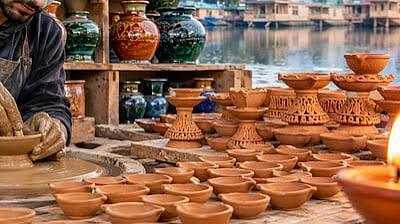
At a pottery workshop in Ishber Nishat, young entrepreneur Mohammad Umer and his family have prepared around 40,000 earthen diyas this year, against nearly 25,000 sold last year. The growing response has encouraged the family to expand production, with orders arriving from within and outside the Valley.
Umer said the workshop began producing diyas during 2020-21 after receiving orders for the traditional lamps. What started as a seasonal activity has gradually developed into a promising business, supported by wholesale buyers and orders through social media platforms.
The workshop produces lamps in different sizes and designs, including traditional small diyas, lamps with stands and decorative arrangements featuring multiple lamps. Online marketing has helped the artisans reach customers beyond Kashmir and explore markets across the country.
The festive demand has also highlighted the potential of Kashmir’s pottery industry to connect traditional craftsmanship with changing consumer preferences. Earthen lamps, an integral part of Diwali celebrations, are giving local artisans an opportunity to find buyers in a market increasingly dominated by factory-made and artificial lighting products.
However, the renewed business activity contrasts sharply with the declining fortunes of the traditional occupation. Kashmiri potters, locally known as Krals, once supplied households with earthen utensils, cooking vessels, water containers and other everyday products. The spread of aluminium, stainless steel, plastic and factory-made crockery has steadily reduced demand for handmade earthenware.
Traditional potters say the occupation, which once supported numerous families across Srinagar and other parts of the Valley, is no longer economically attractive. Many younger members of artisan families are reluctant to inherit the trade because of uncertain earnings, physically demanding work and limited market opportunities.
Umer, a commerce graduate who chose to continue his family occupation, is among those attempting to reverse the trend. Besides expanding diya production, he has been working to revive Kashmir’s distinctive glazed pottery, traditionally associated with the Dal Gate area. The craft is known for its distinctive green, blue, brown and ochre finishes.
The pottery heritage of Kashmir extends beyond household utensils and decorative products. It also includes the tumbaknari, a traditional clay percussion instrument widely used during Kashmiri weddings. The Valley’s pottery tradition has historical roots in the Neolithic settlement of Burzahama, where archaeological evidence traces pottery-making to thousands of years ago.
Despite the encouraging festive orders, artisans face serious constraints. The shortage of quality clay has emerged as a major concern, with Umer saying that the workshop is finding it increasingly difficult to obtain sufficient raw material. He warned that without assured access to clay, meeting future orders and sustaining production could become difficult.
Rising production costs, inadequate facilities, competition from cheaper manufactured products and the absence of reliable market linkages further threaten the sector. Artisans believe that seasonal demand alone cannot secure the future of an occupation that requires sustained investment and institutional support.
There are, however, signs of official intervention. The Union Ministry of Textiles has sanctioned specialised training programmes for the revival of glazed pottery and copperware in Kashmir under the Guru-Shishya Hastshilp component of the National Handicrafts Development Programme. An allocation of Rs 14.90 lakh has been made to the Craft Development Institute, Srinagar, including a glazed pottery training programme in Baramulla for 30 artisans.
Artisans say such initiatives must be accompanied by assured access to raw materials, affordable production facilities, modern equipment, design support and sustained marketing arrangements. Training alone may not be sufficient unless craftsmen are able to earn a dependable livelihood from their skills.
Diversification into contemporary tableware, planters, decorative pieces, customised souvenirs and products for hotels and restaurants could help create demand throughout the year. Digital platforms and organised retail linkages could also enable small workshops to reach customers across India.
The experience of Umer’s workshop demonstrates that traditional pottery can find new buyers when inherited skills are combined with innovation and effective marketing. The challenge now is to extend this opportunity to more artisan families and ensure that Kashmir’s pottery tradition does not survive merely on occasional festive orders, but becomes a viable source of livelihood for future generations.

© Copyright 2023 brighterkashmir.com All Rights Reserved. Quantum Technologies