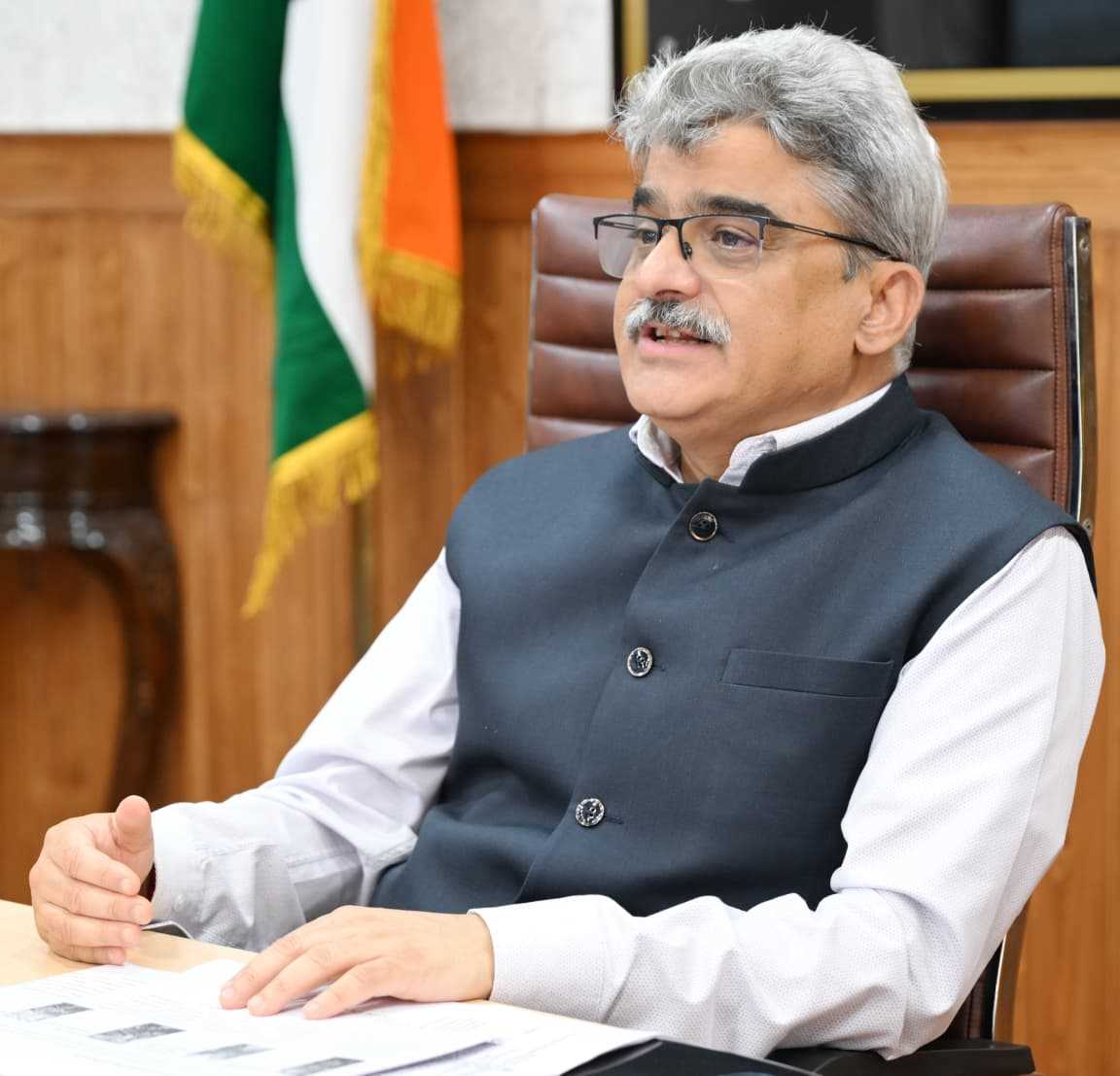
Srinagar, Sep 8: The second day of the first International Film Festival of Jammu & Kashmir (IFFJK-2026) focused on building a sustainable film ecosystem in the Union Territory, with Chief Secretary Atal Dulloo calling for stronger support for local talent, film education, investment and easier shooting permissions.
Speaking at a panel discussion on the J&K Film Policy, single-window clearances and incentives, moderated by film critic and journalist Mayank Shekhar, Dulloo said the festival should not remain a one-time event but serve as a platform for developing a long-term roadmap for the growth of cinema in J&K.
Dulloo said J&K has a natural affinity with the creative arts and recalled the region’s strong association with the film industry during the 1970s and 1980s. He said IFFJK could help revive those connections while providing young people an opportunity to explore filmmaking and allied professions.
Emphasising that cinema involves a wide range of professionals beyond actors and directors, the Chief Secretary stressed the need to develop local human resources. He said the government was exploring scholarships for students seeking specialised filmmaking courses at reputed national institutions and partnerships to bring professional training programmes to J&K.
He also highlighted the role of the Skill Development Mission in creating courses related to filmmaking and its allied fields.
On facilitating film production, Dulloo said procedural hurdles needed to be reduced further. He called for strengthening and simplifying the Single Window Clearance System and said the proposed Ease of Doing Business Bill could help create a more investor-friendly environment for the industry.
Dulloo also urged aspiring storytellers in J&K to develop narratives rooted in their own experiences. Drawing an example from Maharashtra, he said efforts should be made to identify and nurture local writers whose stories could eventually be transformed into film scripts.
“We have numerous stories here. What is required is to hone and chisel this talent and present these stories in the right form and style,” he said.
Commissioner Secretary, Information Department, R. Alice Vaz, outlined the incentives available under the J&K Film Policy, including benefits for productions undertaking substantial shooting in the Union Territory and provisions encouraging the participation of local artists and crew.
She said the policy seeks not only to attract outside productions but also to strengthen the local creative industry. Increased filmmaking, she noted, could generate employment, promote J&K’s cultural heritage and landscapes and provide an additional boost to tourism.
The policy dialogue was complemented by a range of creative and technical sessions at SKICC. Filmmaker Sriram Raghavan conducted a masterclass on directing romantic comedies, while cinematographer Anil Mehta participated in an interaction on framing, lighting and visual storytelling.
Other sessions examined the intersection of regional art with animation, AI and CGI; the changing landscape of independent cinema and film curation; and the craft of acting and character development.
The second day of IFFJK-2026 thus brought together policymakers, filmmakers, technicians and creative professionals, reinforcing the festival’s broader objective of positioning J&K as both a destination for film production and a nurturing ground for its own cinematic talent.

Srinagar, Sep 8: The second day of the first International Film Festival of Jammu & Kashmir (IFFJK-2026) focused on building a sustainable film ecosystem in the Union Territory, with Chief Secretary Atal Dulloo calling for stronger support for local talent, film education, investment and easier shooting permissions.
Speaking at a panel discussion on the J&K Film Policy, single-window clearances and incentives, moderated by film critic and journalist Mayank Shekhar, Dulloo said the festival should not remain a one-time event but serve as a platform for developing a long-term roadmap for the growth of cinema in J&K.
Dulloo said J&K has a natural affinity with the creative arts and recalled the region’s strong association with the film industry during the 1970s and 1980s. He said IFFJK could help revive those connections while providing young people an opportunity to explore filmmaking and allied professions.
Emphasising that cinema involves a wide range of professionals beyond actors and directors, the Chief Secretary stressed the need to develop local human resources. He said the government was exploring scholarships for students seeking specialised filmmaking courses at reputed national institutions and partnerships to bring professional training programmes to J&K.
He also highlighted the role of the Skill Development Mission in creating courses related to filmmaking and its allied fields.
On facilitating film production, Dulloo said procedural hurdles needed to be reduced further. He called for strengthening and simplifying the Single Window Clearance System and said the proposed Ease of Doing Business Bill could help create a more investor-friendly environment for the industry.
Dulloo also urged aspiring storytellers in J&K to develop narratives rooted in their own experiences. Drawing an example from Maharashtra, he said efforts should be made to identify and nurture local writers whose stories could eventually be transformed into film scripts.
“We have numerous stories here. What is required is to hone and chisel this talent and present these stories in the right form and style,” he said.
Commissioner Secretary, Information Department, R. Alice Vaz, outlined the incentives available under the J&K Film Policy, including benefits for productions undertaking substantial shooting in the Union Territory and provisions encouraging the participation of local artists and crew.
She said the policy seeks not only to attract outside productions but also to strengthen the local creative industry. Increased filmmaking, she noted, could generate employment, promote J&K’s cultural heritage and landscapes and provide an additional boost to tourism.
The policy dialogue was complemented by a range of creative and technical sessions at SKICC. Filmmaker Sriram Raghavan conducted a masterclass on directing romantic comedies, while cinematographer Anil Mehta participated in an interaction on framing, lighting and visual storytelling.
Other sessions examined the intersection of regional art with animation, AI and CGI; the changing landscape of independent cinema and film curation; and the craft of acting and character development.
The second day of IFFJK-2026 thus brought together policymakers, filmmakers, technicians and creative professionals, reinforcing the festival’s broader objective of positioning J&K as both a destination for film production and a nurturing ground for its own cinematic talent.
© Copyright 2023 brighterkashmir.com All Rights Reserved. Quantum Technologies