
BREAKING NEWS
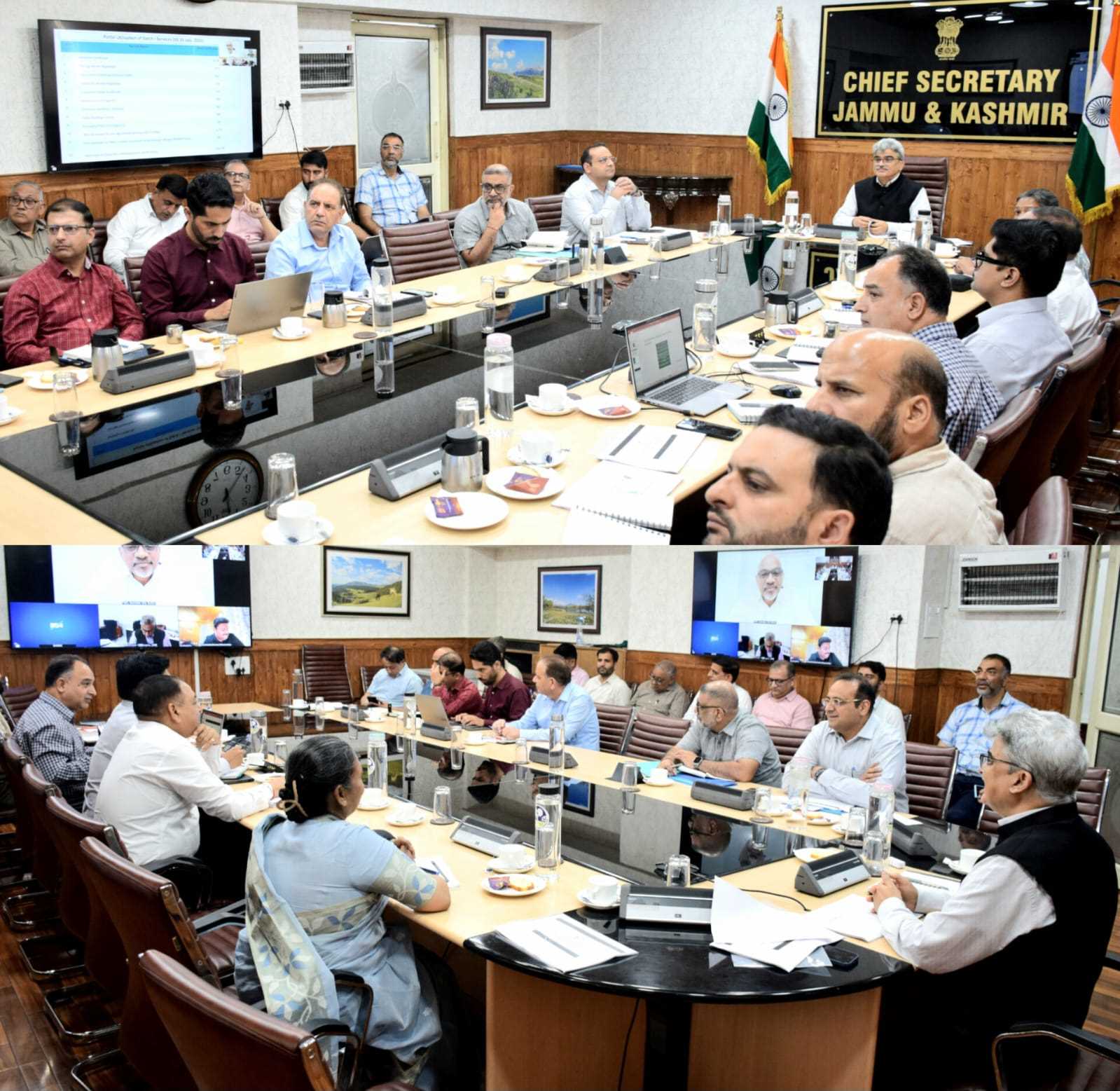
Srinagar, July 16: Chief Secretary, Atal Dulloo on Thursday chaired a high-level meeting attended by the former IAS Officer, P.W.C. Davidar, to deliberate over the roadmap for simplifying government processes across departments with the objective of ensuring greater 'Ease of Living' for citizens and creating a more efficient, transparent and technology-driven governance framework in the Union Territory.
The session focused on transforming service delivery by eliminating procedural complexities, reducing unnecessary compliances and re-engineering government processes to make public services faster, simpler and more accessible for citizens, businesses and government institutions alike.
P.W.C. Davidar, who is also the Advisor to the Government of Tamil Nadu on the 'SimpleGov' initiative, made a detailed presentation on the successful Tamil Nadu model of governance simplification and shared the methodology adopted by the State in streamlining administrative procedures through comprehensive process reforms and digital transformation.
During his presentation, Davidar highlighted that the simplification exercise should encompass all three categories of public services including the Government-to-Citizen (G2C), Government-to-Business (G2B) and Government-to-Government (G2G) with the primary objective of reducing compliance burdens while improving efficiency, transparency and service delivery.
He stressed the need to eliminate avoidable procedural requirements such as physical submission of certificates and documents, obtaining multiple No Objection Certificates (NOCs), licences, permissions and other repetitive compliances that often result in delays and inconvenience to citizens and businesses.
Davidar identified several systemic challenges that require immediate attention, including mandatory physical verification of applicants, lack of clearly defined eligibility criteria, excessive documentation requirements, acceptance of payments through physical modes, repetitive verification at multiple hierarchical levels, reluctance to adopt digital verification mechanisms, inadequate integration of government databases and difficulties in retrieving legacy records from departmental repositories.
Outlining the roadmap for reforms, he emphasized the need for a comprehensive review and re-engineering of existing administrative processes by replacing procedural complexities with citizen-centric governance practices. The roadmap envisages shifting from office-centric procedures to outcome-based governance while ensuring complete end-to-end digitisation of public services.
The meeting was informed that a robust, multi-tier monitoring framework is being established to oversee implementation of the SimpleGov initiative in the Union Territory. The proposed mechanism envisages a Screening Committee to examine reform proposals at the initial stage, while an Empowered Committee headed by the Chief Secretary will provide overall policy direction, monitor progress and facilitate timely implementation across departments.
With regard to the approach for simplification, it was proposed that identification of applicants should be based on a single standardized authentication mechanism, while eligibility criteria should be clearly defined with emphasis on essential requirements and measurable outcomes. It was further suggested that all approvals and government orders be issued online in a standardised format incorporating QR Codes to enable instant verification of authenticity.
The meeting also discussed the legal framework necessary for institutionalising the reforms. It was emphasized that all simplified procedures should be duly backed by relevant Acts, Rules, Government Orders and notified guidelines to ensure legal sanctity, uniformity and ease of implementation.
As an alternative to conventional physical verification, the meeting advocated greater adoption of digital authentication tools such as e-KYC, Digital Signatures, Electronic Verification Codes (EVC), e-Sign, DigiLocker and other nationally recognised digital verification platforms for secure and seamless delivery of services.
It was further proposed that the Government issue a comprehensive Omnibus Order applicable across all departments, clearly laying down the objectives, implementation framework, timelines and responsibilities for simplification of government processes in a uniform and coordinated manner.
Addressing the meeting, Chief Secretary Atal Dulloo noted that substantial groundwork has already been accomplished through the digitisation of nearly 1,500 government services, providing a strong foundation for the next phase of administrative transformation.
He stated that constitution of a multidisciplinary core implementation team, issuance of a comprehensive omnibus order and suitable amendments to existing rules and procedures would form the cornerstone of the reform initiative.
He remarked that the proposed multi-layered monitoring mechanism would ensure effective coordination, accountability and timely execution of the reforms across departments.
Emphasising the importance of learning from successful models, Dulloo suggested that a team of officers from Jammu & Kashmir undertake an exposure visit to Chennai to study the implementation of the Tamil Nadu SimpleGov initiative firsthand. Such an interaction, he observed, would provide valuable insights into best practices and strengthen the Union Territory's strategy for achieving simpler, more transparent and citizen-friendly governance.
Srinagar, July 16: Chief Secretary, Atal Dulloo on Thursday chaired a high-level meeting attended by the former IAS Officer, P.W.C. Davidar, to deliberate over the roadmap for simplifying government processes across departments with the objective of ensuring greater 'Ease of Living' for citizens and creating a more efficient, transparent and technology-driven governance framework in the Union Territory.
The session focused on transforming service delivery by eliminating procedural complexities, reducing unnecessary compliances and re-engineering government processes to make public services faster, simpler and more accessible for citizens, businesses and government institutions alike.
P.W.C. Davidar, who is also the Advisor to the Government of Tamil Nadu on the 'SimpleGov' initiative, made a detailed presentation on the successful Tamil Nadu model of governance simplification and shared the methodology adopted by the State in streamlining administrative procedures through comprehensive process reforms and digital transformation.
During his presentation, Davidar highlighted that the simplification exercise should encompass all three categories of public services including the Government-to-Citizen (G2C), Government-to-Business (G2B) and Government-to-Government (G2G) with the primary objective of reducing compliance burdens while improving efficiency, transparency and service delivery.
He stressed the need to eliminate avoidable procedural requirements such as physical submission of certificates and documents, obtaining multiple No Objection Certificates (NOCs), licences, permissions and other repetitive compliances that often result in delays and inconvenience to citizens and businesses.
Davidar identified several systemic challenges that require immediate attention, including mandatory physical verification of applicants, lack of clearly defined eligibility criteria, excessive documentation requirements, acceptance of payments through physical modes, repetitive verification at multiple hierarchical levels, reluctance to adopt digital verification mechanisms, inadequate integration of government databases and difficulties in retrieving legacy records from departmental repositories.
Outlining the roadmap for reforms, he emphasized the need for a comprehensive review and re-engineering of existing administrative processes by replacing procedural complexities with citizen-centric governance practices. The roadmap envisages shifting from office-centric procedures to outcome-based governance while ensuring complete end-to-end digitisation of public services.
The meeting was informed that a robust, multi-tier monitoring framework is being established to oversee implementation of the SimpleGov initiative in the Union Territory. The proposed mechanism envisages a Screening Committee to examine reform proposals at the initial stage, while an Empowered Committee headed by the Chief Secretary will provide overall policy direction, monitor progress and facilitate timely implementation across departments.
With regard to the approach for simplification, it was proposed that identification of applicants should be based on a single standardized authentication mechanism, while eligibility criteria should be clearly defined with emphasis on essential requirements and measurable outcomes. It was further suggested that all approvals and government orders be issued online in a standardised format incorporating QR Codes to enable instant verification of authenticity.
The meeting also discussed the legal framework necessary for institutionalising the reforms. It was emphasized that all simplified procedures should be duly backed by relevant Acts, Rules, Government Orders and notified guidelines to ensure legal sanctity, uniformity and ease of implementation.
As an alternative to conventional physical verification, the meeting advocated greater adoption of digital authentication tools such as e-KYC, Digital Signatures, Electronic Verification Codes (EVC), e-Sign, DigiLocker and other nationally recognised digital verification platforms for secure and seamless delivery of services.
It was further proposed that the Government issue a comprehensive Omnibus Order applicable across all departments, clearly laying down the objectives, implementation framework, timelines and responsibilities for simplification of government processes in a uniform and coordinated manner.
Addressing the meeting, Chief Secretary Atal Dulloo noted that substantial groundwork has already been accomplished through the digitisation of nearly 1,500 government services, providing a strong foundation for the next phase of administrative transformation.
He stated that constitution of a multidisciplinary core implementation team, issuance of a comprehensive omnibus order and suitable amendments to existing rules and procedures would form the cornerstone of the reform initiative.
He remarked that the proposed multi-layered monitoring mechanism would ensure effective coordination, accountability and timely execution of the reforms across departments.
Emphasising the importance of learning from successful models, Dulloo suggested that a team of officers from Jammu & Kashmir undertake an exposure visit to Chennai to study the implementation of the Tamil Nadu SimpleGov initiative firsthand. Such an interaction, he observed, would provide valuable insights into best practices and strengthen the Union Territory's strategy for achieving simpler, more transparent and citizen-friendly governance.

© Copyright 2023 brighterkashmir.com All Rights Reserved. Quantum Technologies