
BREAKING NEWS
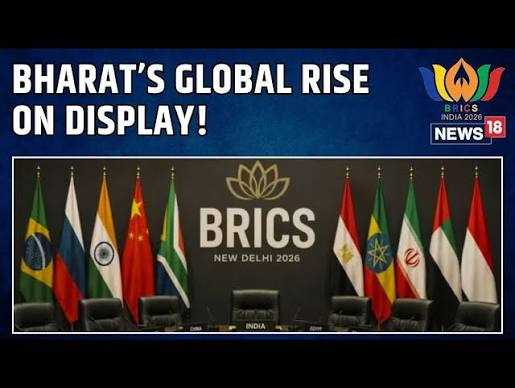
The adoption of the New Delhi Declaration by BRICS marks more than the conclusion of another diplomatic summit. It reflects a changing world order in which emerging economies are seeking a stronger voice, greater strategic autonomy and a more balanced global system. BRICS has evolved far beyond its original economic purpose. Today, it is an important platform for countries that want global institutions to better reflect contemporary economic and political realities. The New Delhi Declaration, therefore, carries significance not merely for its language, but for the direction it signals. For India, the declaration offers an opportunity to reinforce its long-standing commitment to multilateralism. New Delhi has consistently argued that global governance must become more representative, inclusive and responsive to the concerns of developing countries. At a time when geopolitical rivalries are deepening and economic uncertainties are spreading, such a message has renewed relevance. The strength of BRICS, however, lies in its diversity—and that is also its greatest challenge. Its members do not always share the same strategic interests or political outlook. Differences over security, trade, technology and regional conflicts can make consensus difficult. A declaration can express common aspirations, but translating those aspirations into concrete cooperation requires sustained political will. The grouping must therefore avoid becoming merely a forum for statements. Its credibility will increasingly depend on what it delivers: stronger trade and investment links, greater use of local currencies where practical, cooperation in technology and energy, development financing, food and health security, and a meaningful voice for the Global South. The New Delhi Declaration comes at a time when developing countries are demanding greater fairness in international institutions. Reform of the United Nations, international financial architecture and global decision-making mechanisms remains a central concern. BRICS can help build momentum for such reforms, provided it remains focused on constructive engagement rather than bloc politics. India’s role is particularly important. As a founding member and a major voice of the developing world, New Delhi can help bridge differences within the grouping while keeping the focus on practical outcomes. The declaration should thus be viewed as a beginning, not an endpoint. Its real test will come in implementation. If BRICS can convert diplomatic consensus into economic cooperation and institutional reform, it can become a more consequential pillar of the emerging multipolar order. The world is changing rapidly. The New Delhi Declaration suggests that BRICS intends not merely to watch that change, but to help shape it.
The adoption of the New Delhi Declaration by BRICS marks more than the conclusion of another diplomatic summit. It reflects a changing world order in which emerging economies are seeking a stronger voice, greater strategic autonomy and a more balanced global system. BRICS has evolved far beyond its original economic purpose. Today, it is an important platform for countries that want global institutions to better reflect contemporary economic and political realities. The New Delhi Declaration, therefore, carries significance not merely for its language, but for the direction it signals. For India, the declaration offers an opportunity to reinforce its long-standing commitment to multilateralism. New Delhi has consistently argued that global governance must become more representative, inclusive and responsive to the concerns of developing countries. At a time when geopolitical rivalries are deepening and economic uncertainties are spreading, such a message has renewed relevance. The strength of BRICS, however, lies in its diversity—and that is also its greatest challenge. Its members do not always share the same strategic interests or political outlook. Differences over security, trade, technology and regional conflicts can make consensus difficult. A declaration can express common aspirations, but translating those aspirations into concrete cooperation requires sustained political will. The grouping must therefore avoid becoming merely a forum for statements. Its credibility will increasingly depend on what it delivers: stronger trade and investment links, greater use of local currencies where practical, cooperation in technology and energy, development financing, food and health security, and a meaningful voice for the Global South. The New Delhi Declaration comes at a time when developing countries are demanding greater fairness in international institutions. Reform of the United Nations, international financial architecture and global decision-making mechanisms remains a central concern. BRICS can help build momentum for such reforms, provided it remains focused on constructive engagement rather than bloc politics. India’s role is particularly important. As a founding member and a major voice of the developing world, New Delhi can help bridge differences within the grouping while keeping the focus on practical outcomes. The declaration should thus be viewed as a beginning, not an endpoint. Its real test will come in implementation. If BRICS can convert diplomatic consensus into economic cooperation and institutional reform, it can become a more consequential pillar of the emerging multipolar order. The world is changing rapidly. The New Delhi Declaration suggests that BRICS intends not merely to watch that change, but to help shape it.

© Copyright 2023 brighterkashmir.com All Rights Reserved. Quantum Technologies