
BREAKING NEWS
In his preface, Adfar expresses the hope that the book will become a minaret of knowledge and preserve the true essence of Hazrat Noor-ud-Din Noorani for future generations. The work’s enduring value will ultimately depend on how successfully it encourages readers to rediscover the saint’s teachings and apply them to contemporary life.
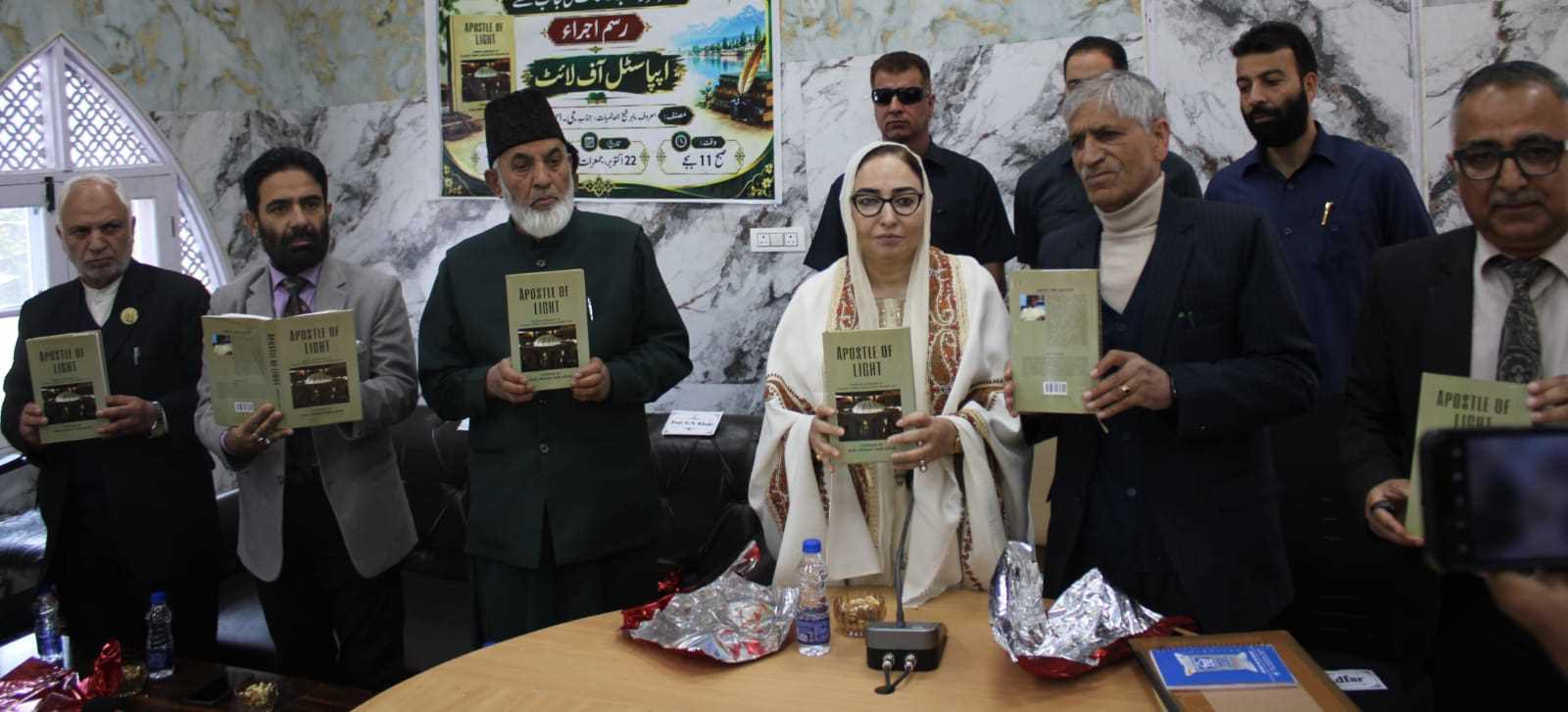
Some books are read for information, others for examinations, and a rare few leave us transformed. Baba Ghulam Nabi Adfar’s Apostle of Light belongs to the fourth category—the kind of book that stays with you long after you have turned its final page.
After more than a decade of research into Persian, Arabic, Sanskrit and Kashmiri sources, Adfar has done much more than write a biography. He has sought to restore a collective memory, reclaim a spiritual heritage and rekindle the light that has guided Kashmir for centuries. That light was embodied in Hazrat Sheikh Noor-ud-Din Noorani (RA), popularly known as Nund Rishi and revered as Alamdar-e-Kashmir, the Flag-Bearer of Kashmir.
According to the author, the book recovers a neglected chapter of Kashmir’s history. Across its 359 pages, 23 chapters and appendices, it presents an attempt to understand Sheikh-ul-Alam not merely as a mystic and ascetic, but also as a philosopher, social reformer, spiritual guide and architect of Kashmir’s distinctive cultural ethos.
Running through this exploration is a question that evokes the enduring mystery of Kashmir’s spiritual and cultural identity: Chi Aatash? Chi Naar?—a question associated in the narrative with Emperor Jahangir’s encounter with a burning Chinar.
The Author and His Roots: Why This Book Matters
To appreciate Apostle of Light, one must understand something of its author. Baba Ghulam Nabi Adfar is not simply a researcher examining a historical figure from a distance. As a son of Chrar-e-Sharief, his engagement with Sheikh-ul-Alam’s legacy is deeply personal.
The destruction of Chrar-e-Sharief in 1995 and the subsequent rebuilding of the town left an enduring imprint on its people. For Adfar, the saint’s biography is therefore not merely an academic undertaking; it is an act of remembrance and a commitment to preserving a heritage that remains central to Kashmir’s collective consciousness.
Written in Jalandhar, far from the spiritual landscape of Chrar-e-Sharief, the book carries the emotional weight of distance and longing. Research and devotion coexist on its pages, giving the work the character of both a scholarly inquiry and a personal tribute.
In his preface, Adfar expresses the hope that the book will become a minaret of knowledge and preserve the true essence of Hazrat Noor-ud-Din Noorani for future generations. The work’s enduring value will ultimately depend on how successfully it encourages readers to rediscover the saint’s teachings and apply them to contemporary life.
From Kashmir’s Soil to the Birth of a Spiritual Tradition
One of the book’s principal strengths is its structure. Adfar does not rush directly into the saint’s life. Instead, he begins with Kashmir itself—its geography, cultural history and mystical traditions.
The opening chapters, grouped under Tuloo-e-Kashmir, establish the landscape in which Sheikh-ul-Alam’s thought emerged. The Chinar, Wular Lake, forests, rivers and mountains are not merely geographical features; they form part of a spiritual imagination in which nature becomes a sign of the Divine.
This approach reinforces the idea that Sheikh Noorani’s spiritual identity cannot be separated from Kashmir’s indigenous traditions. Adfar traces the continuity between earlier Rishi traditions and the emergence of the Muslim Rishi order, presenting Nund Rishi as a distinctive expression of Kashmir’s evolving spiritual culture.
The argument is important because it challenges simplistic interpretations that treat Kashmir’s spiritual history as a succession of disconnected religious influences. Instead, the book explores the ways in which local traditions, Islamic spirituality and the region’s cultural ethos interacted and developed over time.
By placing the saint within this wider historical setting, Adfar gives readers a framework for understanding why his teachings continue to resonate across generations.
The Inner World
The chapters dealing with spiritual reality, meditation, yogic culture, philosophical thought, character and ideal behaviour form the intellectual core of the book.
Here, Adfar moves beyond the familiar image of Sheikh-ul-Alam as a cave-dwelling ascetic. He presents a spiritual thinker whose teachings addressed human conduct, self-discipline, moral responsibility and the relationship between humanity and the natural world.
The discussion of yogic culture and the spiritual relationship between Sheikh Noorani and Lal Ded, the celebrated Kashmiri mystic, is particularly significant. Rather than viewing their connection exclusively through the lens of religious difference, Adfar interprets it as an encounter between two spiritual personalities who drew upon the shared cultural soil of Kashmir.
Their significance lies not in erasing their distinct religious identities, but in demonstrating how spiritual insight can transcend narrow social and communal boundaries.
The book also examines the philosophical dimensions of Sheikh Noorani’s teachings, drawing attention to the universal concerns embedded in his Kashmiri shrukhs—his spiritual verses.
His famous ecological maxim, “Ann poshe teli yeli van poshe”—food will last only as long as forests last—illustrates the practical depth of his thought. It connects spirituality with ecological responsibility and suggests that the preservation of nature is inseparable from the preservation of human life.
In an age of climate change, environmental degradation and unsustainable development, this message acquires renewed urgency.
The Rishi Movement
The section devoted to the Rishi movement is arguably the most consequential part of Apostle of Light. Here, Adfar challenges the perception that Sheikh-ul-Alam withdrew from society and confined himself to private contemplation.
Instead, he portrays the saint as a reformer whose spiritual discipline was closely connected with the welfare of the people.
Four themes recur throughout this interpretation: cultural harmony, social integration, political consciousness and institution-building.
A Tradition of Service
Adfar presents the Rishi order as a model of community life in which spiritual practice, service to humanity and respect for nature were closely linked. The Rishi tradition, in this reading, was not simply about meditation or renunciation; it also encouraged compassion, simplicity and social responsibility.
The khanqahs associated with such traditions served as spaces of spiritual instruction and community interaction. Their significance lay in the values they represented—hospitality, service, restraint and fellowship.
The book invites readers to examine these institutions not merely as relics of the past, but as expressions of a social ethic that remains relevant in a society grappling with inequality, alienation and communal distrust.
Language as a Cultural Legacy
Another important contribution of Sheikh-ul-Alam was his use of Kashmiri as a vehicle for spiritual instruction. His verses spoke to ordinary people in a language they understood, carrying complex moral and spiritual ideas into everyday life.
This linguistic accessibility helped his teachings become part of Kashmir’s collective memory. His shrukhs continue to be recited, discussed and transmitted across generations, demonstrating the enduring power of vernacular literature in preserving cultural identity.
Adfar’s presentation of the original verses alongside translations and commentary is therefore more than a literary exercise. It is an effort to reconnect contemporary readers with a living tradition.
Faith Through Moral Persuasion
The book also emphasises that Sheikh-ul-Alam’s spiritual influence rested on teaching, personal example and the power of his verses. Adfar places this influence within the broader history of Islamic spirituality in Kashmir, including the contribution of Mir Syed Ali Hamadani (RA) and his spiritual legacy.
The result is a portrait of a saint whose faith was expressed not only through personal devotion but also through moral instruction and concern for society.
Legacy: The Voices that Outlive a Saint
The concluding section broadens the narrative through accounts of Sheikh-ul-Alam’s spiritual confluence with Mir Muhammad Hamadani (RA), his passing, the elegy associated with Shum Bi, the marsiya of Baba Dawood Khaki and poetry celebrating his enduring legacy.
One of the most noteworthy features is the attention given to Shum Bi’s elegy. By including a woman’s voice in the remembrance of the saint, Adfar expands the range of perspectives through which Sheikh-ul-Alam’s influence can be understood.
This inclusion is significant because spiritual biographies can sometimes privilege the accounts of male scholars and disciples while overlooking women’s contributions to the preservation of religious and cultural memory.
The elegiac material also gives the book an emotional dimension. It demonstrates that the saint’s legacy survived not merely through formal scholarship, but through grief, poetry, oral tradition and the affection of ordinary people.
The concluding reflections on patriotism and the continuing recitation of his shrukhs further underline the place Sheikh-ul-Alam occupies in Kashmir’s cultural imagination.
Recovering the Dynamic Leader
At the centre of Adfar’s interpretation lies a larger argument: Sheikh-ul-Alam’s legacy cannot be adequately understood if he is remembered only as an ascetic who renounced worldly life.
The author seeks to restore the social and reformist dimensions of the saint’s personality. Drawing on the shrukhs and historical testimonies presented in the book, he highlights themes of moral regeneration, public welfare, enlightenment and collective responsibility.
In this interpretation, Sheikh Noorani was not detached from the concerns of his people. His spirituality offered a way of addressing them.
Adfar also presents him as a figure central to the development of Kashmir’s distinctive ethos of love, sincerity, hospitality and coexistence. The book’s emphasis on these values is particularly relevant at a time when social divisions and competing identities often overshadow the shared cultural experiences of communities.
Its argument is not that Sheikh-ul-Alam’s significance should be reduced to contemporary political categories. Rather, it is that his spiritual message becomes more complete when its social implications are taken seriously.
The saint emerges simultaneously as a mystic immersed in divine contemplation and a reformer concerned with the moral and material condition of society.
Literary and Spiritual Merits
Several features distinguish Apostle of Light.
First, its engagement with primary material. Adfar’s reliance on the saint’s verses gives the discussion a direct connection with the teachings under examination. His willingness to acknowledge uncertainty, where it arises, is also important in a work dealing with centuries of accumulated tradition.
Second, its treatment of Kashmiri literature. The presentation of shrukhs with translation and commentary helps readers engage with the linguistic, philosophical and spiritual dimensions of the verses.
Third, its attention to overlooked voices. The inclusion of Shum Bi’s elegy broadens the narrative and reminds readers that cultural memory is preserved through many voices, not only those of formal scholars.
Fourth, its interpretive ambition. The title Apostle of Light, connected by the author with the idea of a messenger entrusted with a mission, captures the book’s central understanding of Sheikh-ul-Alam as a bearer of spiritual and moral guidance.
Finally, the circumstances of the book’s composition lend it a personal poignancy. Its roots lie in Chrar-e-Sharief, even as the author writes from a place of distance. That emotional connection gives the narrative warmth, though its historical claims must ultimately be assessed through evidence and careful scholarship.
A Book That Demands Patience
At 359 pages, with 23 chapters and appendices, Apostle of Light is not casual reading. Its historical detail, philosophical discussions and scholarly terminology require concentration.
Readers unfamiliar with Kashmir’s Sufi and Rishi traditions may need to proceed slowly. The book’s use of concepts such as cultural harmony, political consciousness and institution-building will be especially useful to researchers, although general readers may occasionally find the discussion demanding.
Those seeking only miraculous anecdotes or romanticised accounts of saints may also find the work different from their expectations. Adfar’s emphasis is on history, ideas, character and social contribution rather than spectacle.
That approach is one of the book’s principal merits. By bringing the reformer into focus alongside the mystic, it encourages readers to engage with the practical implications of Sheikh-ul-Alam’s teachings.
Who Should Read It?
Students of Kashmir’s history and culture will find the book valuable for its attempt to situate Sheikh-ul-Alam within the region’s wider spiritual traditions.
Researchers of Sufism, Kashmiri literature and interfaith interaction may find its discussion of the Rishi movement and its cultural setting particularly useful.
For young Kashmiris, the book offers an opportunity to look beyond the familiar narratives of conflict and rediscover a heritage shaped by spiritual inquiry, moral discipline, respect for nature and concern for humanity.
Its most compelling message is that the past should not be preserved merely as a collection of memories. It should also provide guidance for the present.
In a society searching for ways to strengthen social trust and cultural understanding, Sheikh-ul-Alam’s emphasis on equality, compassion and ethical living deserves renewed attention.
Final Verdict: The Lamp Still Burns
Apostle of Light is an earnest attempt to restore the many dimensions of Hazrat Sheikh Noor-ud-Din Noorani (RA)—the mystic and the reformer, the ascetic and the social thinker, the spiritual guide and the enduring voice of Kashmir.
Its greatest contribution lies in encouraging readers to look beyond the image of a saint who renounced the world and to recognise a figure whose teachings were deeply connected with the life of his people.
The rebuilding of Chrar-e-Sharief after its destruction in 1995 offers a powerful parallel to the book’s own purpose: what is damaged can be rebuilt, and what risks being forgotten can be brought back into public memory.
Baba Ghulam Nabi Adfar has approached this task with the commitment of a researcher and the affection of a son of the soil. The book’s historical arguments invite further study and discussion, but its central appeal is clear: Kashmir’s spiritual heritage deserves to be understood in its full depth, not reduced to familiar labels or fragmented memories.
Six centuries after Sheikh-ul-Alam’s time, his verses continue to speak to questions of faith, humanity, ecology and coexistence. That endurance is itself a measure of his influence.
Apostle of Light invites us to rediscover that legacy—not simply to admire the lamp, but to understand the light it continues to offer.
For anyone seeking to understand why Sheikh-ul-Alam remains such a powerful presence in Kashmir’s collective consciousness, this book is a worthwhile and thought-provoking place to begin.
In his preface, Adfar expresses the hope that the book will become a minaret of knowledge and preserve the true essence of Hazrat Noor-ud-Din Noorani for future generations. The work’s enduring value will ultimately depend on how successfully it encourages readers to rediscover the saint’s teachings and apply them to contemporary life.
Some books are read for information, others for examinations, and a rare few leave us transformed. Baba Ghulam Nabi Adfar’s Apostle of Light belongs to the fourth category—the kind of book that stays with you long after you have turned its final page.
After more than a decade of research into Persian, Arabic, Sanskrit and Kashmiri sources, Adfar has done much more than write a biography. He has sought to restore a collective memory, reclaim a spiritual heritage and rekindle the light that has guided Kashmir for centuries. That light was embodied in Hazrat Sheikh Noor-ud-Din Noorani (RA), popularly known as Nund Rishi and revered as Alamdar-e-Kashmir, the Flag-Bearer of Kashmir.
According to the author, the book recovers a neglected chapter of Kashmir’s history. Across its 359 pages, 23 chapters and appendices, it presents an attempt to understand Sheikh-ul-Alam not merely as a mystic and ascetic, but also as a philosopher, social reformer, spiritual guide and architect of Kashmir’s distinctive cultural ethos.
Running through this exploration is a question that evokes the enduring mystery of Kashmir’s spiritual and cultural identity: Chi Aatash? Chi Naar?—a question associated in the narrative with Emperor Jahangir’s encounter with a burning Chinar.
The Author and His Roots: Why This Book Matters
To appreciate Apostle of Light, one must understand something of its author. Baba Ghulam Nabi Adfar is not simply a researcher examining a historical figure from a distance. As a son of Chrar-e-Sharief, his engagement with Sheikh-ul-Alam’s legacy is deeply personal.
The destruction of Chrar-e-Sharief in 1995 and the subsequent rebuilding of the town left an enduring imprint on its people. For Adfar, the saint’s biography is therefore not merely an academic undertaking; it is an act of remembrance and a commitment to preserving a heritage that remains central to Kashmir’s collective consciousness.
Written in Jalandhar, far from the spiritual landscape of Chrar-e-Sharief, the book carries the emotional weight of distance and longing. Research and devotion coexist on its pages, giving the work the character of both a scholarly inquiry and a personal tribute.
In his preface, Adfar expresses the hope that the book will become a minaret of knowledge and preserve the true essence of Hazrat Noor-ud-Din Noorani for future generations. The work’s enduring value will ultimately depend on how successfully it encourages readers to rediscover the saint’s teachings and apply them to contemporary life.
From Kashmir’s Soil to the Birth of a Spiritual Tradition
One of the book’s principal strengths is its structure. Adfar does not rush directly into the saint’s life. Instead, he begins with Kashmir itself—its geography, cultural history and mystical traditions.
The opening chapters, grouped under Tuloo-e-Kashmir, establish the landscape in which Sheikh-ul-Alam’s thought emerged. The Chinar, Wular Lake, forests, rivers and mountains are not merely geographical features; they form part of a spiritual imagination in which nature becomes a sign of the Divine.
This approach reinforces the idea that Sheikh Noorani’s spiritual identity cannot be separated from Kashmir’s indigenous traditions. Adfar traces the continuity between earlier Rishi traditions and the emergence of the Muslim Rishi order, presenting Nund Rishi as a distinctive expression of Kashmir’s evolving spiritual culture.
The argument is important because it challenges simplistic interpretations that treat Kashmir’s spiritual history as a succession of disconnected religious influences. Instead, the book explores the ways in which local traditions, Islamic spirituality and the region’s cultural ethos interacted and developed over time.
By placing the saint within this wider historical setting, Adfar gives readers a framework for understanding why his teachings continue to resonate across generations.
The Inner World
The chapters dealing with spiritual reality, meditation, yogic culture, philosophical thought, character and ideal behaviour form the intellectual core of the book.
Here, Adfar moves beyond the familiar image of Sheikh-ul-Alam as a cave-dwelling ascetic. He presents a spiritual thinker whose teachings addressed human conduct, self-discipline, moral responsibility and the relationship between humanity and the natural world.
The discussion of yogic culture and the spiritual relationship between Sheikh Noorani and Lal Ded, the celebrated Kashmiri mystic, is particularly significant. Rather than viewing their connection exclusively through the lens of religious difference, Adfar interprets it as an encounter between two spiritual personalities who drew upon the shared cultural soil of Kashmir.
Their significance lies not in erasing their distinct religious identities, but in demonstrating how spiritual insight can transcend narrow social and communal boundaries.
The book also examines the philosophical dimensions of Sheikh Noorani’s teachings, drawing attention to the universal concerns embedded in his Kashmiri shrukhs—his spiritual verses.
His famous ecological maxim, “Ann poshe teli yeli van poshe”—food will last only as long as forests last—illustrates the practical depth of his thought. It connects spirituality with ecological responsibility and suggests that the preservation of nature is inseparable from the preservation of human life.
In an age of climate change, environmental degradation and unsustainable development, this message acquires renewed urgency.
The Rishi Movement
The section devoted to the Rishi movement is arguably the most consequential part of Apostle of Light. Here, Adfar challenges the perception that Sheikh-ul-Alam withdrew from society and confined himself to private contemplation.
Instead, he portrays the saint as a reformer whose spiritual discipline was closely connected with the welfare of the people.
Four themes recur throughout this interpretation: cultural harmony, social integration, political consciousness and institution-building.
A Tradition of Service
Adfar presents the Rishi order as a model of community life in which spiritual practice, service to humanity and respect for nature were closely linked. The Rishi tradition, in this reading, was not simply about meditation or renunciation; it also encouraged compassion, simplicity and social responsibility.
The khanqahs associated with such traditions served as spaces of spiritual instruction and community interaction. Their significance lay in the values they represented—hospitality, service, restraint and fellowship.
The book invites readers to examine these institutions not merely as relics of the past, but as expressions of a social ethic that remains relevant in a society grappling with inequality, alienation and communal distrust.
Language as a Cultural Legacy
Another important contribution of Sheikh-ul-Alam was his use of Kashmiri as a vehicle for spiritual instruction. His verses spoke to ordinary people in a language they understood, carrying complex moral and spiritual ideas into everyday life.
This linguistic accessibility helped his teachings become part of Kashmir’s collective memory. His shrukhs continue to be recited, discussed and transmitted across generations, demonstrating the enduring power of vernacular literature in preserving cultural identity.
Adfar’s presentation of the original verses alongside translations and commentary is therefore more than a literary exercise. It is an effort to reconnect contemporary readers with a living tradition.
Faith Through Moral Persuasion
The book also emphasises that Sheikh-ul-Alam’s spiritual influence rested on teaching, personal example and the power of his verses. Adfar places this influence within the broader history of Islamic spirituality in Kashmir, including the contribution of Mir Syed Ali Hamadani (RA) and his spiritual legacy.
The result is a portrait of a saint whose faith was expressed not only through personal devotion but also through moral instruction and concern for society.
Legacy: The Voices that Outlive a Saint
The concluding section broadens the narrative through accounts of Sheikh-ul-Alam’s spiritual confluence with Mir Muhammad Hamadani (RA), his passing, the elegy associated with Shum Bi, the marsiya of Baba Dawood Khaki and poetry celebrating his enduring legacy.
One of the most noteworthy features is the attention given to Shum Bi’s elegy. By including a woman’s voice in the remembrance of the saint, Adfar expands the range of perspectives through which Sheikh-ul-Alam’s influence can be understood.
This inclusion is significant because spiritual biographies can sometimes privilege the accounts of male scholars and disciples while overlooking women’s contributions to the preservation of religious and cultural memory.
The elegiac material also gives the book an emotional dimension. It demonstrates that the saint’s legacy survived not merely through formal scholarship, but through grief, poetry, oral tradition and the affection of ordinary people.
The concluding reflections on patriotism and the continuing recitation of his shrukhs further underline the place Sheikh-ul-Alam occupies in Kashmir’s cultural imagination.
Recovering the Dynamic Leader
At the centre of Adfar’s interpretation lies a larger argument: Sheikh-ul-Alam’s legacy cannot be adequately understood if he is remembered only as an ascetic who renounced worldly life.
The author seeks to restore the social and reformist dimensions of the saint’s personality. Drawing on the shrukhs and historical testimonies presented in the book, he highlights themes of moral regeneration, public welfare, enlightenment and collective responsibility.
In this interpretation, Sheikh Noorani was not detached from the concerns of his people. His spirituality offered a way of addressing them.
Adfar also presents him as a figure central to the development of Kashmir’s distinctive ethos of love, sincerity, hospitality and coexistence. The book’s emphasis on these values is particularly relevant at a time when social divisions and competing identities often overshadow the shared cultural experiences of communities.
Its argument is not that Sheikh-ul-Alam’s significance should be reduced to contemporary political categories. Rather, it is that his spiritual message becomes more complete when its social implications are taken seriously.
The saint emerges simultaneously as a mystic immersed in divine contemplation and a reformer concerned with the moral and material condition of society.
Literary and Spiritual Merits
Several features distinguish Apostle of Light.
First, its engagement with primary material. Adfar’s reliance on the saint’s verses gives the discussion a direct connection with the teachings under examination. His willingness to acknowledge uncertainty, where it arises, is also important in a work dealing with centuries of accumulated tradition.
Second, its treatment of Kashmiri literature. The presentation of shrukhs with translation and commentary helps readers engage with the linguistic, philosophical and spiritual dimensions of the verses.
Third, its attention to overlooked voices. The inclusion of Shum Bi’s elegy broadens the narrative and reminds readers that cultural memory is preserved through many voices, not only those of formal scholars.
Fourth, its interpretive ambition. The title Apostle of Light, connected by the author with the idea of a messenger entrusted with a mission, captures the book’s central understanding of Sheikh-ul-Alam as a bearer of spiritual and moral guidance.
Finally, the circumstances of the book’s composition lend it a personal poignancy. Its roots lie in Chrar-e-Sharief, even as the author writes from a place of distance. That emotional connection gives the narrative warmth, though its historical claims must ultimately be assessed through evidence and careful scholarship.
A Book That Demands Patience
At 359 pages, with 23 chapters and appendices, Apostle of Light is not casual reading. Its historical detail, philosophical discussions and scholarly terminology require concentration.
Readers unfamiliar with Kashmir’s Sufi and Rishi traditions may need to proceed slowly. The book’s use of concepts such as cultural harmony, political consciousness and institution-building will be especially useful to researchers, although general readers may occasionally find the discussion demanding.
Those seeking only miraculous anecdotes or romanticised accounts of saints may also find the work different from their expectations. Adfar’s emphasis is on history, ideas, character and social contribution rather than spectacle.
That approach is one of the book’s principal merits. By bringing the reformer into focus alongside the mystic, it encourages readers to engage with the practical implications of Sheikh-ul-Alam’s teachings.
Who Should Read It?
Students of Kashmir’s history and culture will find the book valuable for its attempt to situate Sheikh-ul-Alam within the region’s wider spiritual traditions.
Researchers of Sufism, Kashmiri literature and interfaith interaction may find its discussion of the Rishi movement and its cultural setting particularly useful.
For young Kashmiris, the book offers an opportunity to look beyond the familiar narratives of conflict and rediscover a heritage shaped by spiritual inquiry, moral discipline, respect for nature and concern for humanity.
Its most compelling message is that the past should not be preserved merely as a collection of memories. It should also provide guidance for the present.
In a society searching for ways to strengthen social trust and cultural understanding, Sheikh-ul-Alam’s emphasis on equality, compassion and ethical living deserves renewed attention.
Final Verdict: The Lamp Still Burns
Apostle of Light is an earnest attempt to restore the many dimensions of Hazrat Sheikh Noor-ud-Din Noorani (RA)—the mystic and the reformer, the ascetic and the social thinker, the spiritual guide and the enduring voice of Kashmir.
Its greatest contribution lies in encouraging readers to look beyond the image of a saint who renounced the world and to recognise a figure whose teachings were deeply connected with the life of his people.
The rebuilding of Chrar-e-Sharief after its destruction in 1995 offers a powerful parallel to the book’s own purpose: what is damaged can be rebuilt, and what risks being forgotten can be brought back into public memory.
Baba Ghulam Nabi Adfar has approached this task with the commitment of a researcher and the affection of a son of the soil. The book’s historical arguments invite further study and discussion, but its central appeal is clear: Kashmir’s spiritual heritage deserves to be understood in its full depth, not reduced to familiar labels or fragmented memories.
Six centuries after Sheikh-ul-Alam’s time, his verses continue to speak to questions of faith, humanity, ecology and coexistence. That endurance is itself a measure of his influence.
Apostle of Light invites us to rediscover that legacy—not simply to admire the lamp, but to understand the light it continues to offer.
For anyone seeking to understand why Sheikh-ul-Alam remains such a powerful presence in Kashmir’s collective consciousness, this book is a worthwhile and thought-provoking place to begin.

© Copyright 2023 brighterkashmir.com All Rights Reserved. Quantum Technologies