
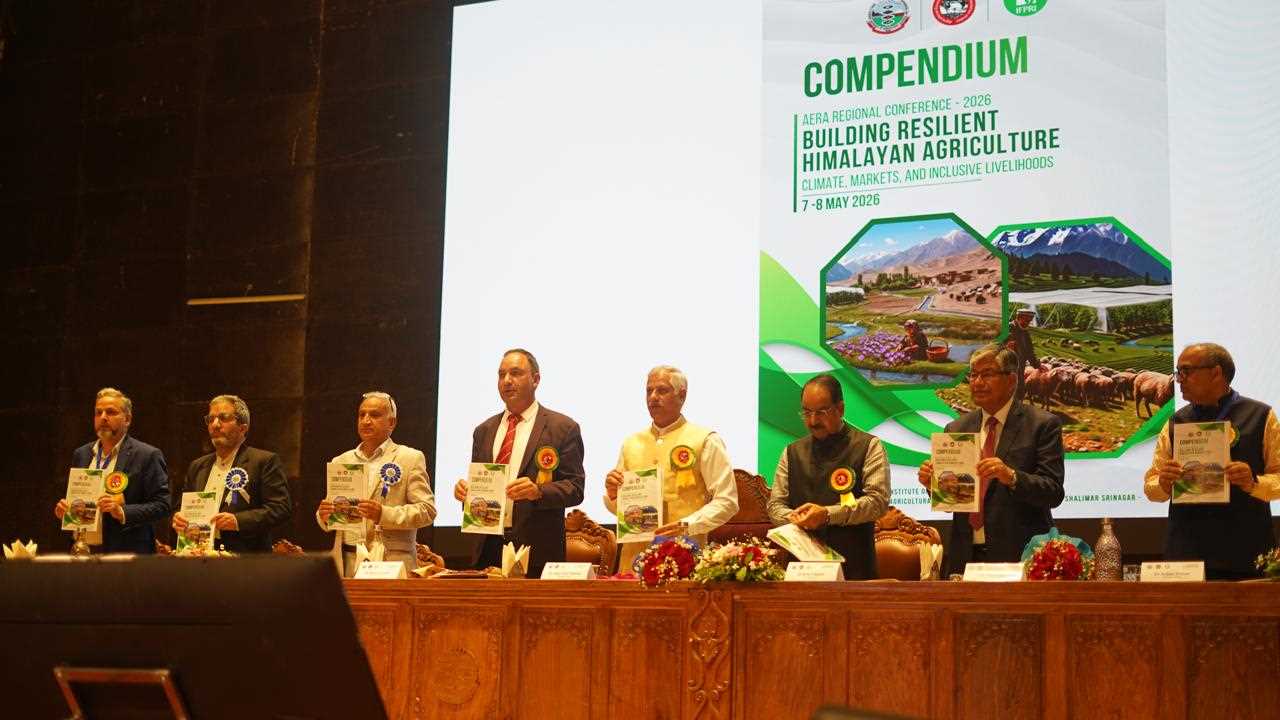
Srinagar, May 7: The AERA Regional Conference on “Building Resilient Himalayan Agriculture: Climate, Markets, and Inclusive Livelihoods” was inaugurated at Sher-e-Kashmir University of Agricultural Sciences and Technology of Kashmir.
The two-day conference, organised by SKUAST-K’s Institute of Business & Policy Research (IBPR) in collaboration with Agricultural Economics Research Association (AERA) and International Food Policy Research Institute, has drawn leading experts from across academia, government, and development sectors to deliberate on the pressing challenges and emerging opportunities in Himalayan agriculture. Over the course of the next two days, the conference will host a series of thematic technical sessions and research presentations covering critical areas such as climate resilience, agri-market reforms, digital transformation, farmer producer organisations (FPOs), and inclusive livelihood strategies. The deliberations are expected to generate actionable policy recommendations and strategic insights aimed at strengthening the resilience, competitiveness, and inclusivity of Himalayan agriculture, thereby contributing to sustainable rural transformation.
Delivering a comprehensive and forward-looking welcome address, Prof Farhet A Shaheen, Organizing Secretary and Head, IBPR, set the intellectual tone of the conference by situating Himalayan agriculture within a rapidly evolving risk landscape. He elaborated that climate variability, declining resource efficiency, and weak market integration continue to undermine the economic viability of farming in the region. He argued for a transition from subsistence-oriented systems to resilient, market-responsive agricultural models, driven by innovation, institutional reforms, and value chain strengthening. Emphasizing inclusivity, he highlighted the need to empower smallholders, women farmers, and rural youth through capacity building and entrepreneurial opportunities.
In a deeply analytical address, Dr Anjani Kumar, IFPRI underscored that the complexity of agrarian challenges in mountainous ecosystems requires robust, data-driven policy responses. He stressed that resilience must be understood not merely as climate adaptation but as a multidimensional construct encompassing economic stability, risk mitigation, and institutional responsiveness. He called for strengthening longitudinal research, impact evaluation, and policy experimentation to design interventions that are both scalable and context-specific. He also highlighted the importance of integrating local knowledge systems with modern scientific approaches.
Guest of Honour Dr BN Tripathi, SKUAST-J provided a strategic institutional perspective, emphasizing that the transformation of Himalayan agriculture hinges on strong inter-institutional collaboration and innovation ecosystems. He elaborated on the need to build efficient agri-value chains that reduce post-harvest losses, enhance value addition, and improve market access for farmers in remote regions. He further stressed the role of universities and research institutions as catalysts for technology dissemination, skill development, and agri-entrepreneurship.
Dr PK Joshi, AERA, highlighted that market integration remains central to improving farm incomes and ensuring long-term sustainability. He elaborated on how digital agriculture, improved logistics, and institutional innovations such as Farmer Producer Organizations (FPOs) can transform fragmented production systems into competitive market-oriented enterprises. He also emphasized that policy coherence across sectors, agriculture, trade, infrastructure, and rural development, is essential to unlock the full potential of the Himalayan agri-economy.
In his address, Vice Chancellor, SKUAST-K, Prof Nazir Ahmad Ganai reaffirmed the university’s commitment to advancing impactful research and policy engagement tailored to the unique challenges of the Himalayan region. He emphasized that the role of academic institutions must extend beyond knowledge generation to include active participation in policy formulation and field-level implementation. He highlighted SKUAST-K’s ongoing efforts in promoting climate-smart agriculture, sustainable resource management, and farmer-centric innovations.
Delivering an insightful keynote, Prof Vijay Paul Sharma, Chairman CACP, presented a comprehensive analysis of agricultural pricing policies in the context of climate risks and market uncertainties. He elaborated on the need for dynamic and adaptive pricing mechanisms that account for regional disparities, production risks, and cost variations. He also stressed the importance of strengthening procurement systems, market intelligence, and institutional support to ensure income security for farmers while maintaining market efficiency and competitiveness.
The inaugural session was moderated by Dr Aiman Fayaz and concluded with a formal vote of thanks by Prof SH Baba, who acknowledged the contributions of distinguished speakers, participants, and partner institutions in making the event a meaningful platform for dialogue and knowledge exchange.
Srinagar, May 7: The AERA Regional Conference on “Building Resilient Himalayan Agriculture: Climate, Markets, and Inclusive Livelihoods” was inaugurated at Sher-e-Kashmir University of Agricultural Sciences and Technology of Kashmir.
The two-day conference, organised by SKUAST-K’s Institute of Business & Policy Research (IBPR) in collaboration with Agricultural Economics Research Association (AERA) and International Food Policy Research Institute, has drawn leading experts from across academia, government, and development sectors to deliberate on the pressing challenges and emerging opportunities in Himalayan agriculture. Over the course of the next two days, the conference will host a series of thematic technical sessions and research presentations covering critical areas such as climate resilience, agri-market reforms, digital transformation, farmer producer organisations (FPOs), and inclusive livelihood strategies. The deliberations are expected to generate actionable policy recommendations and strategic insights aimed at strengthening the resilience, competitiveness, and inclusivity of Himalayan agriculture, thereby contributing to sustainable rural transformation.
Delivering a comprehensive and forward-looking welcome address, Prof Farhet A Shaheen, Organizing Secretary and Head, IBPR, set the intellectual tone of the conference by situating Himalayan agriculture within a rapidly evolving risk landscape. He elaborated that climate variability, declining resource efficiency, and weak market integration continue to undermine the economic viability of farming in the region. He argued for a transition from subsistence-oriented systems to resilient, market-responsive agricultural models, driven by innovation, institutional reforms, and value chain strengthening. Emphasizing inclusivity, he highlighted the need to empower smallholders, women farmers, and rural youth through capacity building and entrepreneurial opportunities.
In a deeply analytical address, Dr Anjani Kumar, IFPRI underscored that the complexity of agrarian challenges in mountainous ecosystems requires robust, data-driven policy responses. He stressed that resilience must be understood not merely as climate adaptation but as a multidimensional construct encompassing economic stability, risk mitigation, and institutional responsiveness. He called for strengthening longitudinal research, impact evaluation, and policy experimentation to design interventions that are both scalable and context-specific. He also highlighted the importance of integrating local knowledge systems with modern scientific approaches.
Guest of Honour Dr BN Tripathi, SKUAST-J provided a strategic institutional perspective, emphasizing that the transformation of Himalayan agriculture hinges on strong inter-institutional collaboration and innovation ecosystems. He elaborated on the need to build efficient agri-value chains that reduce post-harvest losses, enhance value addition, and improve market access for farmers in remote regions. He further stressed the role of universities and research institutions as catalysts for technology dissemination, skill development, and agri-entrepreneurship.
Dr PK Joshi, AERA, highlighted that market integration remains central to improving farm incomes and ensuring long-term sustainability. He elaborated on how digital agriculture, improved logistics, and institutional innovations such as Farmer Producer Organizations (FPOs) can transform fragmented production systems into competitive market-oriented enterprises. He also emphasized that policy coherence across sectors, agriculture, trade, infrastructure, and rural development, is essential to unlock the full potential of the Himalayan agri-economy.
In his address, Vice Chancellor, SKUAST-K, Prof Nazir Ahmad Ganai reaffirmed the university’s commitment to advancing impactful research and policy engagement tailored to the unique challenges of the Himalayan region. He emphasized that the role of academic institutions must extend beyond knowledge generation to include active participation in policy formulation and field-level implementation. He highlighted SKUAST-K’s ongoing efforts in promoting climate-smart agriculture, sustainable resource management, and farmer-centric innovations.
Delivering an insightful keynote, Prof Vijay Paul Sharma, Chairman CACP, presented a comprehensive analysis of agricultural pricing policies in the context of climate risks and market uncertainties. He elaborated on the need for dynamic and adaptive pricing mechanisms that account for regional disparities, production risks, and cost variations. He also stressed the importance of strengthening procurement systems, market intelligence, and institutional support to ensure income security for farmers while maintaining market efficiency and competitiveness.
The inaugural session was moderated by Dr Aiman Fayaz and concluded with a formal vote of thanks by Prof SH Baba, who acknowledged the contributions of distinguished speakers, participants, and partner institutions in making the event a meaningful platform for dialogue and knowledge exchange.

© Copyright 2023 brighterkashmir.com All Rights Reserved. Quantum Technologies